
Siemens EcoProp
Your next yacht may be powered with a new, but at the same time old and extensively proven, power system-a diesel electric drive. First used in 1903 to propel the triple-screw Russian tanker Vandal on the Volga River and Caspian Sea, diesel electric propulsion is now used in the most modern cruise ships and in thousands of other commercial vessels. Although the idea of powering your yacht with the indirect, two-step diesel electric energy transfer system may appear to be unnecessarily complex, its many advantages can make it a compellingly attractive alternative to a conventional direct mechanical prop-shaft drive.
The benefits of diesel electric drive begin with the design freedom the system affords the yacht’s designer. The engine can be installed wherever appropriate to achieve optimum use of space for the accommodation. Noise and vibration are more easily suppressed than in a conventional direct engine-to-propeller drive. Turning the props with electric motors enhances slow-speed maneuverability by providing unrestricted minimum prop speeds with 100 percent torque available to provide immediate power response at all times. Prop synchronization is automatic and extremely precise. When under way all of the electrical power required by the vessel can be supplied from the diesel electric propulsion system, eliminating the need to run a genset. A diesel electric power system can drive multiple propellers from a single engine or use multiple engines to power one or more props. In a twin-engine/twin-prop system, one engine can power both props when operating within the speed limits imposed in many areas. Electrical power from the vessel’s genset can be used to propel the boat, providing a built-in backup-especially valuable for yachts with single-engine installations. Conversely, the propulsion system can serve as a backup for the yacht’s gensets.
The more than 100-year history of marine diesel electric systems began as a response to the impossibility of quickly reversing the direction of rotation of early direct-to-prop-shaft-coupled diesel engines. With a diesel-powered direct current (DC) generator and a DC motor connected to the prop shaft, the direction of prop rotation could be controlled by a switch. The 100 percent torque, zero-speed capability of the electric motor led to the overwhelming use of diesel electric power for railroad locomotives. Diesel electric drives found a natural application in submarines and many surface ships. Today’s cruise ships, where 70-80 percent of the total onboard power is required for the “hotel” side of the vessel, are diesel electric powered. The power demands can be enormous at times. A trivial example: 1,500,000 watts, equal to more than 1,400 hp, is needed to simultaneously power half of the 1,500-watt hair dryers on a 1,400-stateroom cruise ship.
While the equipment designed to serve the massive needs of cruise ships is unsuitable for any reasonable-sized yacht, numerous land-mobile applications including buses, very large trucks and the cranes used in container ports need power levels similar to those required by a yacht. These land-mobile applications require high overall efficiency, installation flexibility, virtually 100 percent torque at close to zero speed and must meet demanding reliability and durability standards. Fortunately, equipment designed and perfected for these uses is ideal for propelling many types of yachts.
From the helmsman’s standpoint the Siemens diesel electric propulsion system is totally transparent, functioning identically to a conventional power control system, with some welcome and useful advantages. In a twin-prop installation, two conventional-appearing single-lever electronic power controls send commands to the drive control system computer (DICO in Siemens’ terms). Digital messages from the DICO manage the diesel engine’s speed governor and control the current flow from the propulsion converters to the prop-drive motors. The power curve of the engine is programmed into the control computer and used to set engine rpm to the speed that provides the required power with optimum fuel efficiency. It is generally unnecessary for the helmsman to monitor engine rpm. Placing a prop control in neutral allows the prop to freewheel, with no risk of damaging the gearbox, a benefit when the vessel is propelled by the other prop. There are no restrictions on rapid movement of the control from ahead to astern. Moving both controls beyond a preselected prop shaft speed, usually about 400 rpm, will automatically and very precisely synchronize the propellers. In fact, the precision with which the system “knows” the relative rotational position of each prop shaft appears to be sufficient to allow future addition of a prop-phase relationship control. Vibration and noise can be minimized with careful control of the relative position of the blades on one prop with those on the other prop. This technique is common on many multiengine aircraft and is called prop phasing.
In a diesel electric system, the engine can be mounted virtually anywhere in the hull and in whatever orientation is required to achieve optimum use of space. With no need to provide a mechanical power-transfer connection to the hull, the engine mounts can be chosen for optimum vibration isolation. If desired, the engine can be totally enclosed in a sound shield, providing superior sound attenuation without the need to insulate an entire compartment. The incorporation of thrust bearings on the prop shafts ensures precise alignment with the “P” bracket and the prop-drive gearbox, reducing wear on the cutlass bearing and shaft noise. The small size of the prop-drive motor and gearbox also makes it possible to locate the props at the most advantageous position on the hull-a great advantage.
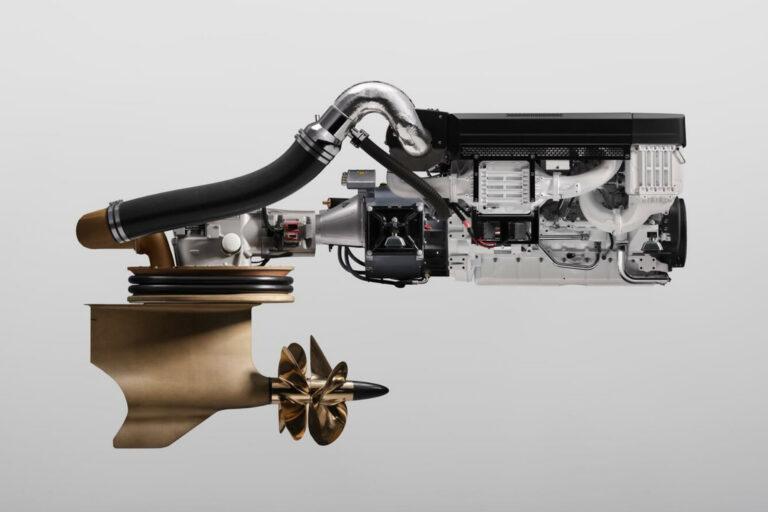
A typical Siemens single-engine twin-prop diesel electric propulsion system is comprised of a permanent magnet three-phase alternator powered by the diesel engine through a speed-increasing gearbox, two short-circuit-proof solid state power inverter modules, two 3-phase permanent magnet prop-drive motors, associated prop-drive gearboxes, a control computer and a conventional-appearing helm control station. System components are surprisingly compact and lightweight. The 145 kW (194 hp) alternator suitable to power a 48-foot trawler yacht is 10 inches square, 22 inches long and weighs 264 pounds. Each of the 114 hp drive motors is similar in size and weight. The 40 x 23 x 7 inch inverter modules are typically bulkhead mounted. The spiral bevel gearboxes used to connect the alternator to the driving engine and the drive motors to the propellers are 98 percent efficient and have a medium duty life expectancy of 25,000 hours. Gearbox power capacities range from 150 to 600 hp, meaning that they can be coupled to multiple alternators or motors to meet the power requirements of larger vessels. All of the system’s power-handling components, alternators, motors, gearboxes and power inverters are cooled with a circulating flow of water/glycol. The system is also continuously monitored, by using temperature sensors built into the alternators, motors, gearboxes and inverters.
Operating efficiency is an important part of the evaluation of any power delivery system. Although the alternators, inverters, motors and gearboxes used in the Siemens system operate efficiently, the total energy loss through the system will typically exceed the losses imposed by a conventional marine gear-coupled drive. However, the efficiency loss is to a large degree offset by the ability of the electronic control to precisely match the engine’s power curve to the vessel’s propellers. In a conventional direct mechanical prop-drive system, the fixed pitch propeller can be matched to the engine and the hull at only one point, maximum engine rpm. At all other engine speeds the engine turns faster than is necessary to produce the required power. The diesel electric drive matches the prop load to the engine, producing a result similar to that achieved with use of a controllable pitch prop. Using one large engine to power two propellers can provide an efficiency advantage compared with use of two engines providing the same total power. Depending on the positioning of the engine, power loss due to exhaust backpressure may be less than what can be achieved in a conventional installation. The option of drawing the vessel’s AC house power from the propulsion system when under way, eliminating the need to run the vessel’s genset, can improve fuel efficiency. Overall, the fuel economy of the diesel electric drive will be close to or as good as what can be achieved using a direct-drive system.
In many installations the cost of a single-engine twin-prop diesel electric power system will be no more than a conventional twin-engine direct-mechanical drive installation. Properly integrated into the design of the vessel, the diesel electric drive’s many attributes will likely make it the preferred propulsion system for a growing number of yachtsmen.
Contact: www.sea.siemens.com/marine/.