Cast your mind back to your first smartphone. Its design, user interface and connected capabilities seemed impressive. Then, just as you started wishing for a faster processor or a better camera, the next-generation model arrived, touting big advances. But, as hardware and software rapidly improved, you likely experienced less compulsion to regularly refresh your device.
Flagship multifunction displays have followed a similar trajectory. While this is good news for budget-minded yacht owners, it places greater emphasis on each new product release. Given that Simrad introduced its last flagship multifunction display, the NSO evo3, in 2018 and refreshed it in 2020 with the NSO evo3S, this year’s NSO 4 announcement had my attention.
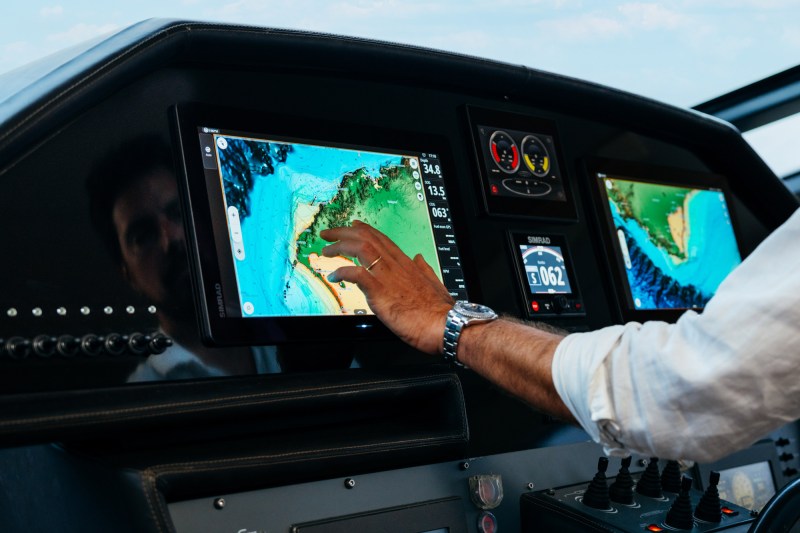
Contemporary MFDs have networking capabilities, processing power and touchscreen-based user interfaces that make them the nerve centers aboard most modern yachts. Simrad’s fully redesigned NSO 4 product line is several tidelines higher than Simrad’s previous top-end glass, boasting a more intuitive user interface, faster processing and response speeds, better charts and far better networking capabilities.
NSO 4 displays are available in three sizes: 16 (6,500),22(10,000) and 24 inches ($12,000), and can be purchased with a standard worldwide base map or be upgraded by spec’ing C-Map’s Discover X charts (this adds $100). Additionally, all three MFDs support select third-party cartography, and they can simultaneously support multiple charts on split-screen views.
All three models deliver glass-to-edge screens with rounded corners, full HD resolution and touchscreen-only interfaces (Simrad’s OP-55 external keypads are sold separately). NSO 4 displays support four-way camera splits that help bolster helm-side situational awareness, and they have Simrad’s SolarMax IPS displays, which allow readability in direct sunlight through polarized sunglasses.
Then there’s NSO 4’s onscreen presentation. “We’ve refreshed the LCD modules to provide higher-quality displays, a more consistent white point across the entire range, and we’ve optimized screen-to-case ratio, allowing larger displays to fit in smaller spaces,” says Stephen Thomas, product director of electronic solutions for Navico Group, which owns Simrad Yachting.
All three NSO 4 offerings sport Qualcomm 8-core processors, which Simrad says yield instantaneous responsiveness to user commands, 35 percent quicker boot-up times and 10 times faster auto-routing processing speeds than NSO evo3S displays. Additionally, NSO 4 displays have 128 gigabytes of onboard storage, and four M12 gigabit Ethernet ports, a USB-C connector, an NMEA 2000 port, dual microSD card slots, and video-in and video-out ports.
Of these connectors, the four M12 gigabit Ethernet ports represent the biggest advancement, allowing NSO 4 displays to move data 10 times faster than NSO evo3S displays.
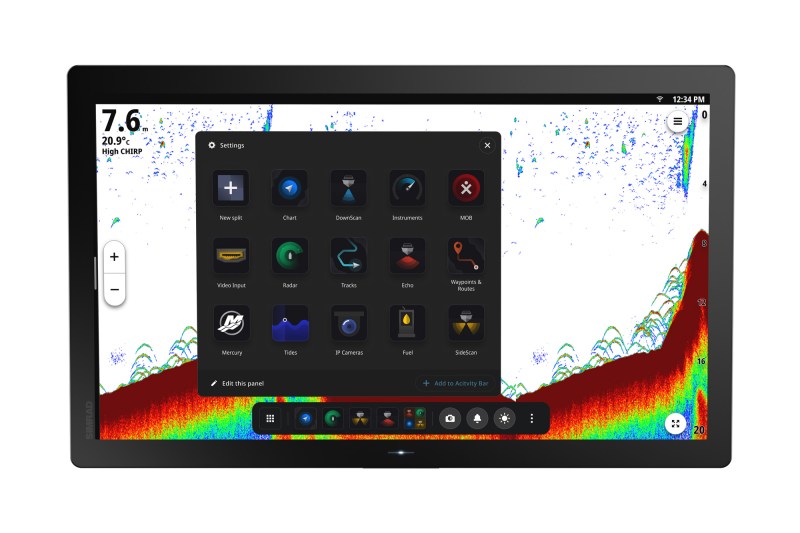
In terms of software, NSO 4 has Simrad’s Android-based Neon operating system. “We built Neon OS around three core principles: clarity, speed and predictability,” Thomas says. He describes clarity as reducing clicks, and making features and information easily accessible, while speed refers to instant responsiveness to user commands and faster auto-routing computations.
“Predictability,” Thomas says, “meant creating a system that behaves consistently, with intuitive search, guided setup and intelligent device detection, and a layout users can customize to match how they boat—from drag-and-drop tiles to personalized instrument bars and home screens.”
All told, Simrad describes the NSO 4 family as its most intuitive chartplotters.
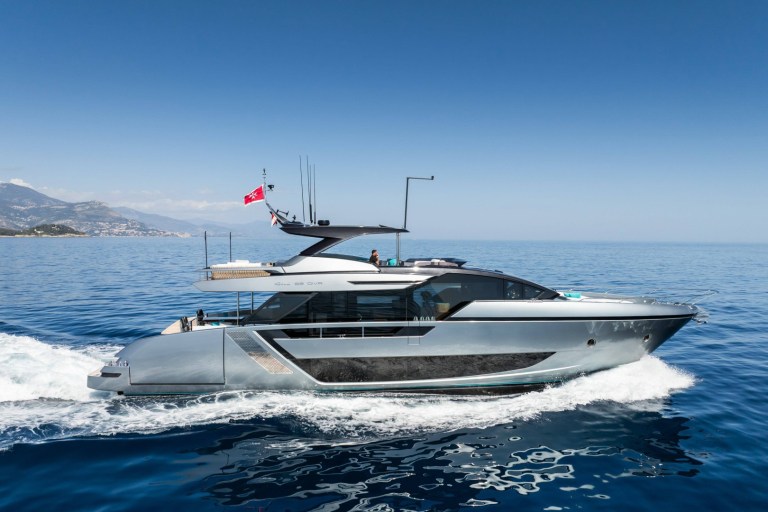
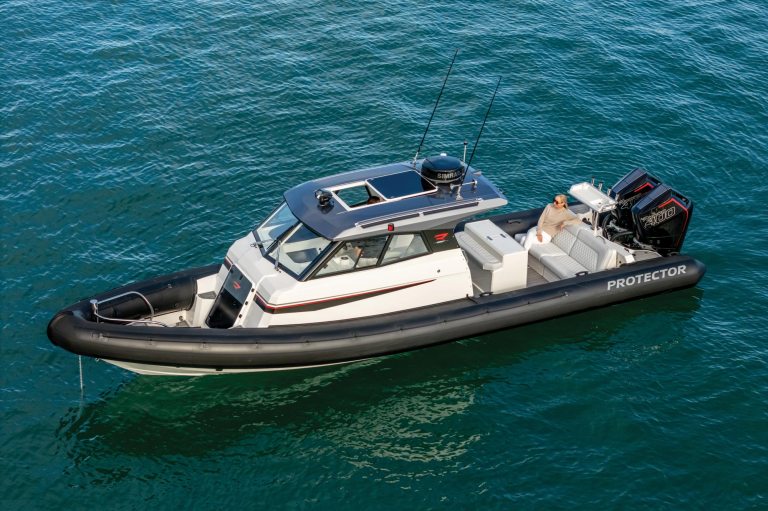
“NSO 4 is our premium offshore product,” Thomas says, noting that all three models deliver stem-to-stern vessel integration that includes compatible engines, digital-switching systems, lightning, video and audio equipment. “It is designed for large console boats that often accommodate multiple displays. These include everything from the adventure dayboats and sportboats [to] premium luxury yachts and high-performance offshore boats.”
Given the intended market, NSO 4 displays were designed with anglers in mind. But instead of embedding fish-finding technology into NSO 4’s architecture, Simrad designed its newest displays to work with compatible external sonar modules.
This also makes it easier for owners to refresh their MFDs without having to rethink their under-keel acoustics.
“We strive to make NSO 4 as backward-compatible with older sensors as much as we can to make updating systems easier,” Thomas says, adding that backwards compatibility also extends to radars and autopilots.
And, given NSO 4’s four gigabit Ethernet ports and other hard-wire connectivity options, Simrad’s flagship MFDs were created to handle the data-transfer needs of today’s—and tomorrow’s—sensor networks.
While contemporary PCs are commonly marketed with integrated AI capabilities, Thomas says that NSO 4 doesn’t include onboard artificial intelligence. Instead, NSO 4 plays nicely with other networked sensors and systems that leverage AI.
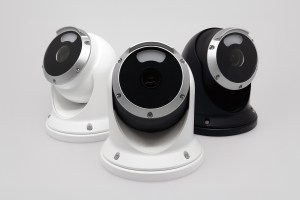
An example of off-board AI is Simrad’s AutoCaptain autonomous-docking system, which Thomas says was designed to be used with NSO 4 displays. Each AutoCaptain system includes a black-box processor and six depth-perceiving cameras for 360-degree, around-the-yacht awareness. These cameras use a kind of AI called machine vision to differentiate between water and non-water objects.
Another example, Thomas says, is Simrad’s FishCast Powered by Roffs (sold separately), which uses AI to predict ideal angling opportunities.
In both cases, the heavy AI lifting is tackled by dedicated upstream processors or cloud-based computers, while NSO 4 screens present the information.
This approach also has an added benefit for owners: AI technology moves fast, and the cost and complication of replacing a sensor or black-box processor is often less painful than replacing glass. This strategy fits with Simrad’s product map, which tends to make flagship display releases rarer than Olympic medal ceremonies.
So, if you cast or cruise with Simrad equipment and have been pining for an upgrade to your existing multifunction display, or if you’re spec’ing Simrad gear for a new build, check out NSO 4. After all, odds are good that you’ll be at least one (or three) smartphones farther down the road before NSO 4’s relief watch arrives.
Upgrades and Installations
While Simrad offers NSO evo3S and NSO 4 displays in 16- and 24-inch sizes, NSO 4’s height and width metrics are smaller, meaning cutouts aren’t compatible. That said, NSO 4 offers a new tool-less rear-mount design that Thomas says is easier to install and service than Simrad’s older hardware.