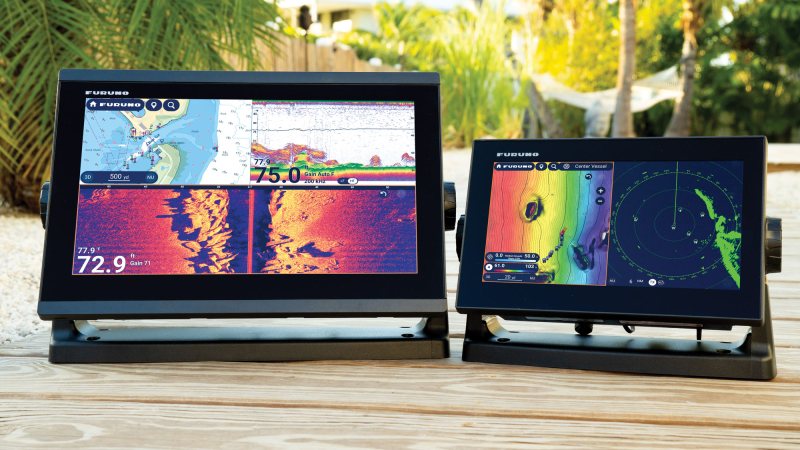
Late evening was easing into full-blown darkness on Florida’s Indian River as Capt. Jeff Gauthier returned to his home port of Stuart at 30 knots aboard his Hewes Bayfisher 18. That’s when his Furuno TZtouch13E multifunction display and networked DRS4D-NXT radar started issuing Doppler-based alerts warning of a dangerous target in the middle of the channel.
Gauthier changed course to avoid calamity, then cautiously circled back to investigate the red splotch on his 13-inch screen. A palm tree’s root ball was peeking above the waterline, with plenty more submerged density. “It probably saved me a hole in my boat,” he says.
Not bad for one of Furuno’s entry-level screens.
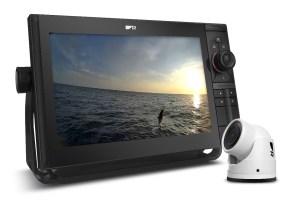
For years, Furuno primarily focused on building electronics for big cruising and fishing yachts, and for commercial vessels. While Furuno’s TZMap and TZtouchE multitouch displays are the smallest screens in the company’s MFD pantheon, they’re delivering angler-pleasing features that help acquaint fish with hooks, and are giving cruisers the right navigation tools. Their tidy 9- and 13-inch footprints make the MFDs easy fits aboard a wide variety of vessels, and their over-the-air cartography and operating-system updates simplify system maintenance.
While the two MFD families look identical, share many capabilities and specs and utilize the same streamlined versions of Furuno’s operating system, the key differentiator is that TZMap displays are standalone systems while TZtouchE MFDs can be networked with other Furuno-built equipment. “They’re the same, but what separates them is the software,” says Tim Moore, Furuno’s East Coast general manager. “We’re just trying to give people a less-expensive thing, and by doing that, we try to think away any complexities.”
Some of these thought-away complexities involve radars and sonars. While TZMap MFDs ($1,600 to $2,400) have Furuno’s TruEcho Chirp, continuous-wave and Chirp Side-Scan fishfinders, they can’t be networked with downstream black-box sonars. Likewise, TZMap MFDs only work with compatible Furuno analog and digital radome-enclosed radars, not bigger open-array sensors.
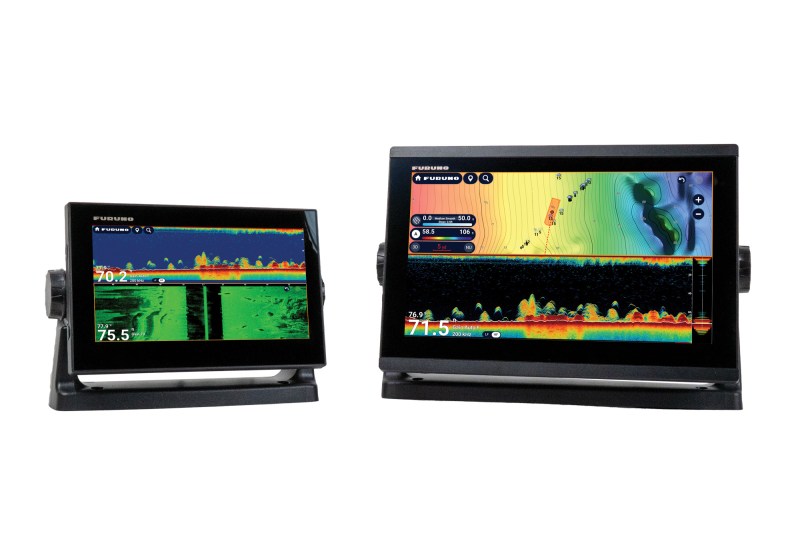
“Our assumption is [a TZMap is] going on a smaller boat anyway, so the chances of [an owner] putting an open array on probably just isn’t going to happen,” Moore says.
While TZMap customers face more sensor limitations than TZtouchE customers do, both systems have the same processors. This, Moore says, allows TZMap displays to support Furuno’s AI’s Routing, which automatically plots safe routes based on a vessel’s beam, draft and other parameters, and vector chart data.
Likewise, all four MFDs come with an NMEA 0183 and an NMEA 2000 port, letting the screens display networked NMEA data. Their HTML5 architecture allows them to control some downstream equipment.
Furuno’s TZtouchE MFDs, priced from $2,200 to $3,010, look just like their younger siblings, but they aren’t as stripped down.
“We broke it down to the essentials you would need to get a great-working little unit and just give you [what] you need without overcomplicating things,” Moore says, noting that the “E” in the TZtouchE’s moniker means “essential.” “You can drop that TZtouch9E or 13E into a TZTouchXL network, and it’s going to perform in line with the XLs, just in a much smaller footprint,” he says.
This means that while TZtouchE MFDs have the same embedded fish-finding capabilities as the TZMap series, they can also display and control compatible multibeam black-box sonars, including Furuno’s CSH10 omni sonar. “That’s important for the guys putting [TZtouchE MFDs] on the tower,” Moore says.
Then there’s radar. TZtouchE MFDs work with compatible Furuno-built analog and digital radome-
enclosed and open-array radars, the latter of which deliver better range, target separation and situational awareness.
The E-series has AI, which includes the same AI Routing found aboard TZMap MFDs, plus Furuno’s Risk Visualizer and AI Avoidance Route, which use Doppler processing to help mariners avoid collisions and automatically plot routes around obstacles.
If it sounds like the E series falls between Furuno’s entry-level TZMap MFDs and the company’s bigger XL-series screens, you’re on the right tack. As a result, Moore says, he’s seeing customers spec’ing TZtouchE MFDs as the primary glass aboard smaller rides, and as secondary screens aboard trawlers and offshore boats.
“A lot of these trawler owners want to put less-expensive, smaller MFDs down in their staterooms,” Moore says.
All four MFDs come with pre-installed NOAA vector charts for US coastal waters, and all four support TZ Maps of Timezero, a Furuno sister company. These charts start at $150 for the stand-alone TZMap MFDs, and are $265 for the networkable TZtouchE displays, with $20 subscription fees after the first year. Cartography and operating-system updates are handled wirelessly, so long as the MFD is connected to a Wi-Fi network.
“The cool part about these charts is they’re built for everybody,” Moore says, noting that TZ Maps includes Timezero’s bathymetric, raster and vector charts.
Additionally, Moore says, TZ Maps delivers free weather forecasts, giving mariners information ranging from wind, waves and rain to angler-specific insights including chlorophyll and sea surface temperatures. “If there’s chlorophyll near a temperature break, chances are pretty good you’re going to do some good pelagic fishing,” he says.
Furuno’s smallest screens have small form factors that can be bracket- or flush-mounted and user-friendly interfaces that are like Furuno’s bigger XL-series MFDs. That said, TZMap and TZtouchE MFDs don’t support daylight or thermal-imaging cameras. While this could be a consideration for owners of bigger yachts, it’s important to remember that if a TZtouchE is part of a bigger Furuno-built XL installation, other networked MFDs can handle this lift.
For yachtsmen who cast or cruise with Furuno equipment and are seeking a smaller screen for a stateroom, flybridge or tower—or a primary screen for a side ride—TZMap and TZtouchE MFDs could be worth exploring. As for dodging semi-submerged root balls, all four MFDs are up for the challenge, so long as they’re networked with the right radars and are used by operators who know their boats, local waters and reaction times.
Integrated Controls
Furuno’s TZMap and TZtouchE multifunction displays have HTML5 architecture. This allows all four MFDs to control more than 35 different third-party devices through the embedded NavNet Command Center, which is Furuno’s HTML5 interface. This list is growing, and currently ranges from battery-charging systems to thrusters.