How to Choose a Tender
Tenders may just be the Rodney Dangerfields of the yachting world. They’re expected to start and run flawlessly on a moment’s notice and perform myriad tasks during a given trip — everything from ferrying passengers and gear to pulling kids on a wakeboard. And once someone owns a tender, he or she gives it the bare minimum of maintenance and care.
Disrespect notwithstanding, yachtsmen make more than their fair share of blunders when choosing a tender. Errors run the gamut from the wrong size vessel to improper propulsion to poor gear to material mistakes. We talked to the experts to ensure you’re better equipped when selecting your next tender — whether you respect the little boat or not is up to you. Here’s what we found.
**
Measuring Up:**
The first mistake people often make when choosing a tender is being lazy about taking measurements. They often don’t measure the space available on their boat or the height of the opening if the boat is to be stored in an enclosed area. Other dimensions should also be considered.
“It’s a much more technical sale than people expect,” said Skip Reisert, owner of Tender Care Boats in Fort Lauderdale, Florida (www.tendercareboats.com). “Someone tells a yacht owner he can fit a 13- foot tender on his boat, but it becomes 14½ feet as soon as he puts up the tilt on the outboard.”
Reisert and other dealers say that tender buyers often come in with the wrong size or even the incorrect brand in mind. It’s often recommended that a yacht owner have the company that installed the davits or hydraulic swim platform come to the boat to recommend a size for the tender.
While a tender might fit dimensionally, don’t forget about the possibility that it can restrict boarding access. If a boat with a beam of 14 feet has a transom door at about the 12-foot mark, having a 12-foot tender blocks that entryway.
You Get What You Pay For:
If failing to measure is the first mistake people make during tender selection, being cheap or going too small is definitely the second. In many cases, the tender is one of the last decisions a person makes. Sometimes an owner doesn’t want to spend any more money, and other times he doesn’t want to have to make any more decisions, so he just takes the cheapest thing he comes across.
“There’s almost sticker shock when people see how much these boats cost,” said Jarrett Bryzek of International Yacht Network (www.iynboats.com).
Mission Possible:
In addition to measuring, tender buyers need to think about how they’ll use the smaller boat. If it’s going to spend most of its time on the davit or swim platform and rarely be deployed, that’s one thing, but if you know that your tender is going to be in operation frequently, don’t just focus on price.
When a couple or family comes into his facility, the first thing Bryzek does is sit the wife down in a boat. “She says, ‘It’s too small. We can’t fit the kids and the luggage and the golden retriever.’” That way he doesn’t have to try to sell too hard. They see for themselves that they need to choose a boat that’s big enough to meet the requirements of their family.
Added Sunset Inflatables’ Mitch Bernardo of Huntington Beach, California, “I have to remind [owners] that once you get where you’re going, you’re going to spend all your time on your tender.”
Power Trip:
With boat size addressed, the next likely mistake is the propulsion system, including the amount and type of power. Most owners want maximum power, which some dealers feel is just an American idiosyncrasy. Because fuel prices are higher in Europe, boaters on the other side of the Atlantic don’t automatically demand the biggest engine they can get.
The overpowering pandemic is especially rampant with new lightweight tenders such as those from Walker Bay and the Nano series by Nautico. On the 12-foot Widebody Nautico series, International Yacht Network recommends a 50-horsepower outboard, but the 12-footer in the Nano series is so much lighter that it needs only a 25-horsepower motor and planes in less time when so powered. On a 14-foot Nano with a towing arch, a 40-horsepower motor was actually faster than a 60-horsepower motor when tested because the bigger one weighed down the boat. Bernardo explained that putting the maximum-size motor on a boat might do more harm than good. “Put a 60-horsepower on a 14-foot tender and it’s well tempered,” he said. “Put on the 75 and the boat can become unruly.”
Conversely, underpowering a boat will make the engine work harder to ferry people back and forth between the mother vessel and shore. If you bought the tender because the dealer told you it has enough power to pull a wakeboarder and it can’t pull your kid up on a board, you’re going to hear about it from Junior.
Bernardo feels that a tender’s transom height also factors into how much power it should have, which makes sense. His rule is that a boat with a 20-inch-tall transom needs at least a 40-horsepower motor while a 12-foot or shorter boat with a 15-inch transom will work better with a 30-horsepower outboard.
If you’re not tied into a specific type of power based on the design of a boat’s garage (see “It’s Launch Time,” below), consider where you’ll be using the tender and what you want it to do when you select the propulsion. Jets are often faster, but they’re also no fun to drive at slow speeds and a little more difficult to get used to because there is no neutral. “You’re oversteering so much your arms are ready to fall off,” Bryzek said with a laugh. Additionally, most service technicians feel that they’re tougher to maintain than outboards or stern-drives.
**
Material World:**
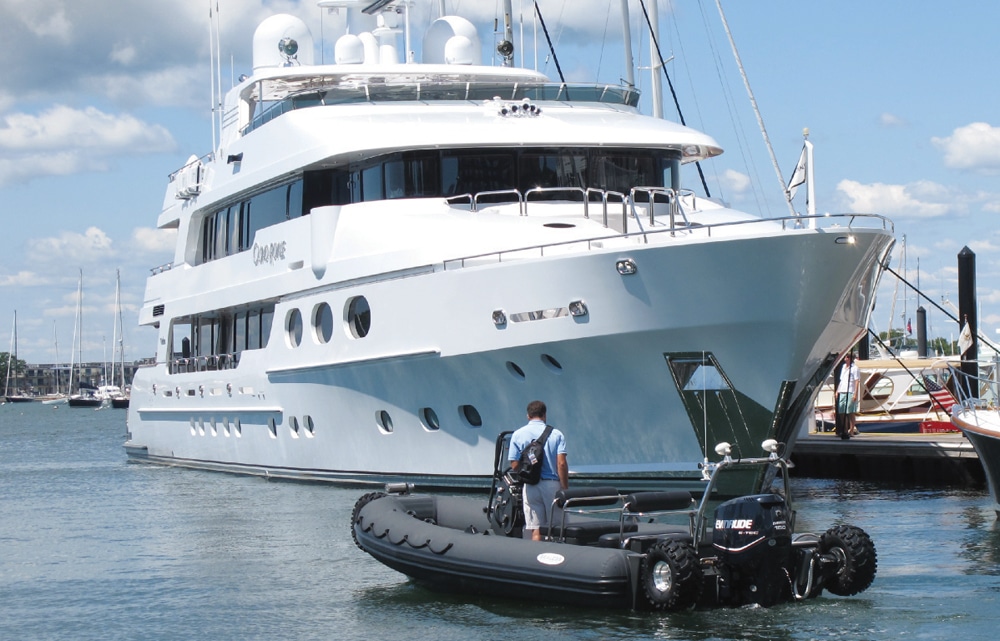
Virtually all tenders on modern yachts are rigid-hull inflatables, and you need to know the differences in the materials that tubes are made from before making a selection. If you boat in the Northeast, Great Lakes or Pacific Northwest, you can buy a boat made with PVC tubes without worrying and save some money in the process. PVC is less expensive than hypalon, from which many RIB manufacturers make their tubes. If you live in or spend most of your time in a tropical climate, don’t buy PVC. It does not hold up well in strong sun and will cost you money in the long run.
It’s Launch Time:
If your boat has a stern garage, certainly a popular design element on a new boat, you need to do a little homework. For example, Fairline doesn’t require it but strongly recommends a Williams jet RIB for its new Targa 50’s garage. If you’re looking for a new tender for a pre-owned yacht that you’ve recently purchased, don’t go to the dealer locked in on a specific tender because it might not be the best fit for your boat.
As with any purchase, a tender decision needs to be seriously considered. “The real key is giving some thought to what’s important,” Bernardo said. So is giving your tender some respect.