Huckins Yachts
During the post-World War II boating boom, Huckins yachts were special. They were elegant, with pug-nacious profiles and ang-ular, masculine styling. They were fast, wringing maximum speed from the relatively low horsepower engines available at the time. And they were comfortable: Sailors who’d broken their backs aboard Elco PTs during the war found the Huckins to be as smooth riding as a Barcalounger. Today, 77 years after Frank P. Huckins built his first Fairform Flyer, a Huckins is still something special.
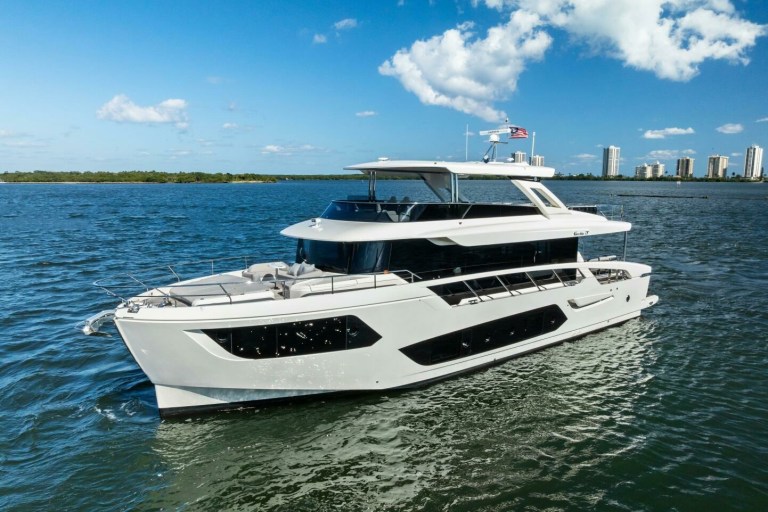
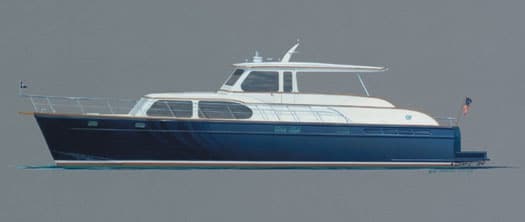
Take a look at this new Linwood 56. From a distance, it’s almost indistinguishable from the same boat built in the Eisenhower days, although instead of double-diagonal mahogany planking, its hull is built of stitched E-glass and vinylester resin over a closed-cell foam core. Below the waterline, the new Linwood rides on basically the same Quadraconic hull Frank Huckins first drew in 1928 (although it has been fine-tuned over the years). Unlike the deep- and modified-V hulls common today, in the Roaring Twenties most speedboats rode on low-deadrise bottoms that twisted to almost flat in the after sections; they were fast, but incredibly hard-riding. The Quadraconic hull is also nearly flat aft, but with a little more deadrise forward and concave sections along its full length to minimize pounding. Huckins created the bottom by developing, through complex mathematical formulas, four conical shapes, then marrying them to create his hull-hence, “Quadraconic. The design has proven over 77 years of hard use to be just as Huckins promised: fast, efficient, quick to plane and seaworthy at both planing and displacement speeds.
One of the keys to the original Huckins’ superior performance was lightness of weight, and at just 48,000 lbs. the Linwood 56 maintains the tradition. (For comparison, a 54 Hatteras convertible weighs 74,000 lbs.; a 57 Bertram, 76,000.) A lighter weight requires less horsepower, and Huckins designers predict 30 knots with a pair of 660 hp diesels under the hood; typically, a yacht of this length demands twin 1,000 hp diesels, minimum. Smaller engines also burn less fuel. As designed, the Linwood 56 carries its engines way aft, under the cockpit, and spins the props through V-drives. But the first Linwood has twin 670 hp Cummins engines driving Hamilton waterjets. Thanks to the increased efficiency of waterjets and the lower drag of a shaft-, strut-, prop- and rudder-free bottom, the folks at Huckins expect the boat to run a little bit faster. This will be the first Huckins coming from the factory with waterjets, but not the first overall: A 1948 Huckins Offshore 64 was recently rebuilt and repowered with twin Detroit Diesels 8-92TAs and KaMeWa FF375 waterjets (original power was triple 6-71 Detroits); in its new incarnation, the boat makes 30 knots, while drawing less than 30 inches. Waterjets will make the Linwood 56 an ideal gunkholer as well as an efficient, economical offshore cruiser.
Huckins has drawn two “standard accommodations plans, but since each Linwood 56 is custom-built, there’s room for change-just bring your checkbook. The first boat has the two-stateroom arrangement, with an enormous master aft, saloon and open galley midships, plus a second stateroom forward. Both staterooms have queen berths on the centerline, and en suite heads-two heads in the master, sharing a single shower. How would Frank Huckins, who kept his boats as Spartan as the market would allow, react to his-and-hers heads? Maybe he’d opt to convert one head into an office; it would make a perfect out-of-the-way place to carry on ship’s business, write in the log, plan voyages on the computer or even surf the Net. (Maybe renew one’s Yachting subscription online?) Unless the owner and mate are overly obsessed with private functions, this might make better use of space.
Folks needing three staterooms can choose to lose about a quarter of the master stateroom, and one of the aforementioned heads, to add a smaller cabin with twin single berths lying athwartships, just forward of the master. This layout adds another head, not en suite to the third cabin, but across the passage between the master stateroom and the saloon. It will also serve as a day or guests’ head and keep folks heeding nature’s call out of the private staterooms. The three-stateroom plan also shaves a bit of volume from the saloon.
The two- and three-stateroom plans handle the galley differently as drawn, although mixing and matching shouldn’t cause a problem. In the two-stateroom layout, the saloon and centerline galley are connected by a countertop ideal for serving a light breakfast or lunch, or just wasting time over coffee. It lets the cook participate in whatever’s happening in the saloon, and vice-versa. Folks passing into the forward stateroom walk outboard of the galley and down a couple of curving steps. This circuitous passage adds some privacy to the forward stateroom, since there’s no direct sightline from the saloon or galley into the cabin. The three-stateroom layout moves the galley to port, a couple of steps down from the saloon and separated from it; the galley, forward stateroom and forward head live on the same level in this arrangement. In both cases, the galley is fitted with refrigerator and freezer drawers, an electric cooktop and a microwave oven.
Both arrangements have pluses and minuses. The two-stateroom plan provides a spacious saloon and master stateroom, ideal for a cruising couple who spend lots of time aboard and need their space, but who want room for another couple to join them now and then. With no single berths, this plan limits the guest list to couples (or free-thinkers). The three-stateroom layout provides more berths, including two singles for kids or guests preferring not to share, but at the cost of both private space, in the master, and public, in the saloon. Fortunately, there’s a third option: Ask the Huckins designers to come up with a plan that suits all your needs. That’s the advantage of working with a custom builder-each buyer can have what he or she wants, rather than adapt to a cookie-cutter plan. Huckins customizes almost all of its boats, so they are ready with sharpened pencils to design just what you want. Maybe they can change the forward stateroom from a single queen to V-berths, for example.
The Linwood 56’s bridge has a single helm seat on the centerline, facing Huckins’ trademark mahogany-spoked steering wheel, and a companion/navigator’s bench seat to port, with stowage underneath. There’s plenty of room for electronics, and even space to lay out a chart. Wraparound seats at the aft end of the bridge will be favorite places for lounging or enjoying a cool drink from the wet bar. Isinglass curtains will roll right down, making a cozy retreat for waiting out a change in the weather, or maybe a hand or two of bridge after a pleasant day of cruising. Access to the below-decks accommodations is from the bridge, and there are centerline steps to the cockpit from here, too.
The topsides, deck and superstructure of the Linwood 56 are finished in mirror-smooth Awlgrip, with varnished mahogany toe rails, coverboard and accent moldings. The transom platform is teak. Cleats are a custom Huckins design in chrome-on-bronze. (In keeping with the look of the yacht, maybe bronze would be appropriate instead. Get a kid to do the polishing.) Tempered-glass deckhouse windows port, starboard and forward provide natural light in the saloon and galley; there’s only a single hatch, over the forward berth. The side decks are wide and uncluttered, for easy line handling and general messing about on deck. A 12-volt anchor windlass/gypsy is standard.
Access to the twin Cummins, Caterpillar or Volvo diesels is through hatches in the cockpit. Some folks dislike V-drives because they add another layer of mechanics to maintain and repair, but the arrangement moves the engines way aft, and makes for easy maintenance and repair without disrupting the saloon. Each Linwood 56, like all Huckins yachts, will have top-class mechanical and electrical systems conforming to ABYC or USCG standards. A 20kW generator is standard, with room for a 6kW night genset. Five bilge pumps, two 20-gallon water heaters and multizone air-conditioning are standard.
Contact: Huckins Yacht, (904) 389-1125; www.huckinsyacht.com