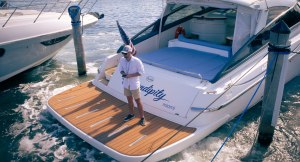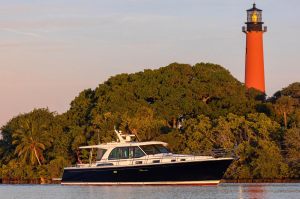
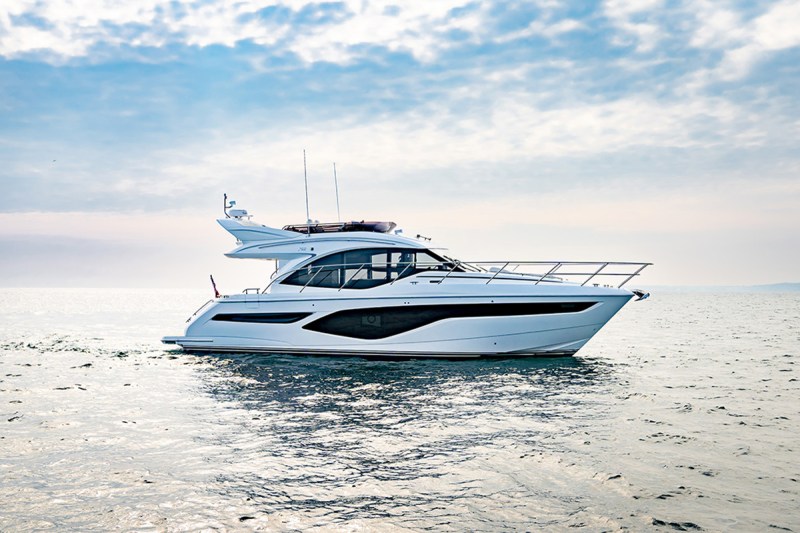
When Princess Yachts launched the F50 in 2019, it arrived at the culmination of something the Plymouth-based builder had been quietly perfecting for years. The F Class range, Princess’s flagship series of flybridge cruisers, had been undergoing a complete overhaul, model by model, and the F50 was the final piece. It needed to prove that Princess could take everything the company had learned across decades of flybridge development and distill it into a yacht compact enough for an owner-operator to handle alone, yet refined enough to feel unmistakably like a Princess.
It has done exactly that.
The F50 is the product of a collaboration between the Princess Design Studio and Bernard Olesinski, the naval architect whose partnership with Princess stretches back to 1980. Over the course of 40 years, that relationship has shaped the look and feel of virtually every Princess model built in the modern era, and its influence on the F50 is evident from the first glance.
The exterior carries Princess’s contemporary design language. It features an extended knife-edge hull window running from the bow, the elimination of the central windscreen spear for improved visibility, and the sporty aft canopy lines that have become signatures of the F Class identity.
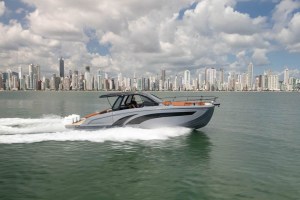
Underneath, the F50 rides on an advanced resin-infused deep-V hull that keeps weight down and stiffness high, delivering a top speed of up to 36 knots from twin Volvo D8-IPS 800 engines producing 1,200 combined horsepower.
The hull was engineered to do more than move fast. The deep-V form provides lift and reduces drag underway, while the Volvo IPS pod drive system (with joystick control at both helm stations) gives you precise, intuitive handling and makes tight marina approaches feel routine. The forward engine placement keeps weight low and balanced, which helps the hull rise onto plane without excessive bow lift and hold a flat, dry ride.
Owners and reviewers repeatedly echo the fact that the F50 is one of the most approachable owner-run flybridges in its class, and that accessibility is by design.
Three Decks, One Philosophy
What sets the F50 apart from competitors in the 50-foot flybridge segment is the way every space on the yacht connects to every other space with a logic that feels intuitive.
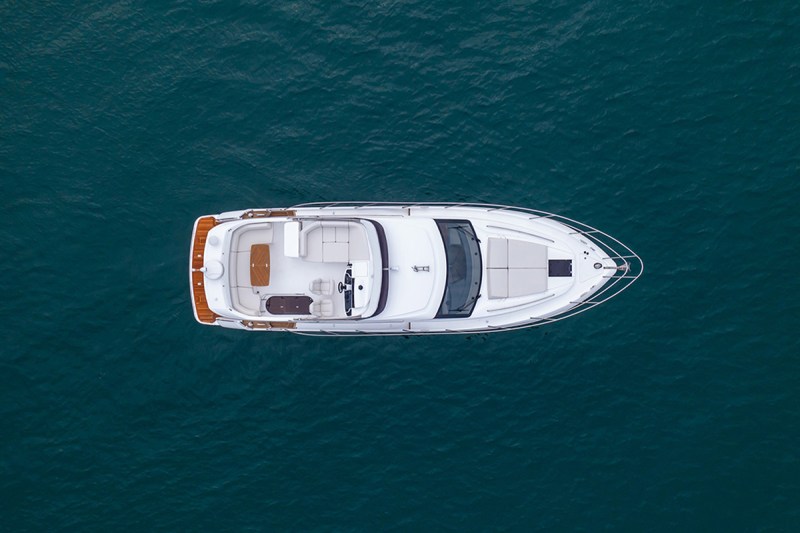
The cockpit, shaded by the flybridge overhang, is the first space guests encounter. It’s social by nature, with a teak table, comfortable seating, and a full enclosure track system that makes the area usable in any weather. Triple stainless-steel framed sliding doors open to the main saloon, where an aft galley finished in satin walnut puts the chef steps away from both the cockpit and the interior dining area. A full-height fridge freezer, three-burner electric hob, oven, and ample storage make the galley genuinely functional for extended cruising.
The saloon itself features a U-shaped sofa and dining table for six that can convert to a double berth, a two-seater settee, and a lower helm station equipped with twin multifunction displays and Volvo-Garmin navigation. Large windows flood the space with natural light. Inside, the room feels significantly larger than its footprint would suggest, as Olesinski designs tend to.
Forward on the main deck, the teak foredeck features a generous sunpad, accessible via wide, safe side decks with high guardrails.
The flybridge, though, is where the F50 earns its keep. For a 50-footer, the space up top is remarkably generous: a U-shaped seating area aft with a folding teak table, an L-shaped sofa to port that converts to a sunbed, twin helm seats with an adjustable steering wheel, and an optional wet bar with barbecue, sink, and refrigerator. The upper helm mirrors the lower station’s functionality with its own set of navigation screens and joystick control, and the elevated sightlines make piloting from the flybridge a genuine pleasure.
This space works equally well for a couple with sunset cocktails and for a family of six that wants to spend the afternoon at anchor.
Efficient Below Decks Space
The F50 accommodates up to six guests across three cabins, two of which are en-suite. The layout that punches well above what most buyers expect at this length.
The full-beam master stateroom amidships is the centerpiece. With a large double bed, ample headroom, free-flowing walkways on either side, non-mullioned hull windows for maximum natural light, a vanity table, and a deep wardrobe, it feels more like a cabin from a 60-footer than a 50. The en-suite features Avonite floors and countertops, and the overall sense is one of genuine livability. Owners can comfortably spend weeks here, and often do.
Forward, the VIP guest cabin offers its own en-suite bathroom and a large double bed with the option of scissor berths that convert between twin and double configurations. The skylight overhead is a detail that owners report loving. It turns the forward cabin into something special at anchor, especially under a full moon.
The third cabin to starboard provides twin berths, so it’s ideal for children or additional guests. All three cabins benefit from the F50’s sweeping hull glazing, which ensures natural light reaches well below the waterline.
The Owner-Operator’s Yacht
The F50 was conceived for the kind of buyer who wants the refinement and build quality of a much larger Princess but intends to run the yacht themselves. That design philosophy shows in decisions both large and small.
The Volvo IPS system with joystick docking means an experienced owner can handle the F50 solo in most conditions. Dual-station helm controls on both the main deck and flybridge provide flexibility depending on conditions and preference. The hydraulic hi-lo swim platform accommodates a Williams 285 tender or jet ski and doubles as an easy boarding point. Noise and vibration at cruise are well contained, making extended passages comfortable rather than fatiguing.
Available technology further enhances the ownership experience. Gyro stabilizers reduce roll at anchor and underway. Volvo Penta’s Easy Boating system simplifies the interface between captain and machine. And the Volvo-Garmin navigation suite across both helm stations gives the F50 a level of electronic sophistication that owners stepping up from smaller boats will appreciate immediately.
Owners who have added aftermarket touches like Seakeeper stabilization and Starlink satellite internet have found the F50 readily accommodates the upgrades, which makes it easy to extend its capabilities for long-range cruising.
The F50’s three-cabin layout makes it particularly well suited for multigenerational use; grandparents in the master, kids or guests forward, and everyone congregating on the flybridge for dinner as the sun goes down. It’s a yacht built around the premise that time on the water is time spent together.
The Formula, Perfected
Like every Princess, the F50 is hand-built at the company’s facility in Plymouth, England, by the same craftsmen who construct the builder’s 80- and 90-foot models. The fit and finish (from gel coat application to the satin walnut joinery, from the Perrin & Rowe sink fittings in the bathrooms to the handcrafted teak details throughout) reflects a level of consistency that has defined the brand for six decades.
Princess celebrated its 60th anniversary in 2025, and in those six decades the brand has demonstrated a depth of institutional knowledge behind every model in the lineup. The F50 is a direct beneficiary of that heritage. It doesn’t try to reinvent the flybridge, but refines it, drawing on lessons learned across more than half a century of building yachts in the same shipyard, with the same commitment to craft.
In a segment with no shortage of competent 50-foot flybridge options, the Princess F50 distinguishes itself through balance. It’s fast enough to be exciting, at 36 knots, without sacrificing the planted, composed ride that Princess owners expect. It’s spacious enough to cruise comfortably for weeks with six aboard, but manageable enough for an owner to dock single-handed. It’s technologically current without being complicated, and luxurious without being ostentatious.
That balance is the product of a builder that understands that the owner is the captain. And when the captain is also the one who chose the boat, maintained the boat, and brought the family aboard for the weekend, every detail matters. The Princess F50 gets those details right.