
About four years ago, a Solar Wave 64 from the Silent Yachts shipyard crossed the Atlantic Ocean. That trip was before the current chairman, Steve Bell, got involved with the company. He wanted to understand how far the technology had progressed. So, to compare a transatlantic this past winter aboard a Silent 62, Bell reached out to the crew of that other boat.
“I talked to that captain,” Bell says. “It used double the fuel. We’ve got more solar panels, so that’s just an improvement in the efficiency of the technology.”
The crossing that Bell did with the Silent 62’s owner and two other crewmembers had a number of goals. “This showed that we have a yacht that can go across the oceans,” he says. “It’s more than capable of going out in 15- or 16-foot waves. It’s uncomfortable, but you can do it.”

The crossing was a bucket-list checkmark for the SY62’s owner, who had a lifelong ambition to complete a transatlantic. It also created an opportunity to collect data that Bell says gave him all sorts of ideas for what Silent Yachts might be able to offer its customers in the future.
“Some of the people who buy our yachts are geeky,” he says. “They want to see all the data, know exactly what they’ve used, what they will use. The software development is huge in what we’re trying to do. We’re thinking about maintenance on a daily basis, where it logs like a full-service history. My brain was spinning about how to make all of that better.”
His mind had plenty of time to dream up ideas because the crossing itself, he says, was largely uneventful in other ways. Anyone who does this kind of passagemaking knows that things often break on boats, but on this journey, Bell says, there was thankfully precious little drama of that sort. “It’s a software-driven vessel. When your computer doesn’t work, you turn it off and turn it back on. We did that a couple of times,” he says. “And we had to change a generator impeller. We had enough spares on board to build another yacht. We ended up not needing them.”

For much of the time, he says, the owner was logging extensive data about fuel burn, generator use and more. “We were out there for five weeks without a problem,” Bell says. “We could have slowed down and used a lot less fuel, maybe by a knot and a half. We would have taken probably six or seven weeks, not five weeks. But I know what it’s like on a yacht for five weeks at a time. The human factor is really important. People get a little bit stir crazy day in and day out.”
They did the crossing in November and December to take advantage of what are typically favorable conditions between Europe and the Caribbean—but that also meant being out there at a time that’s suboptimal for a solar-electric vessel in terms of the sun’s position in the sky. “There’s a thing called the Northern Equatorial Current that runs from Cape Verde to the Caribbean,” he says. “It starts about October, November, December, and you get about a 1-knot current behind you, plus about 15 knots of trade winds behind you, and you’re missing the hurricane season. This is the time to do a crossing from Europe to the U.S., but the sun is quite low below the equator.”
Even with that limitation, he says, the SY62 was able to operate in silent mode, on battery propulsion, for 72 percent of the time. The rest of the trip, the generator was running.
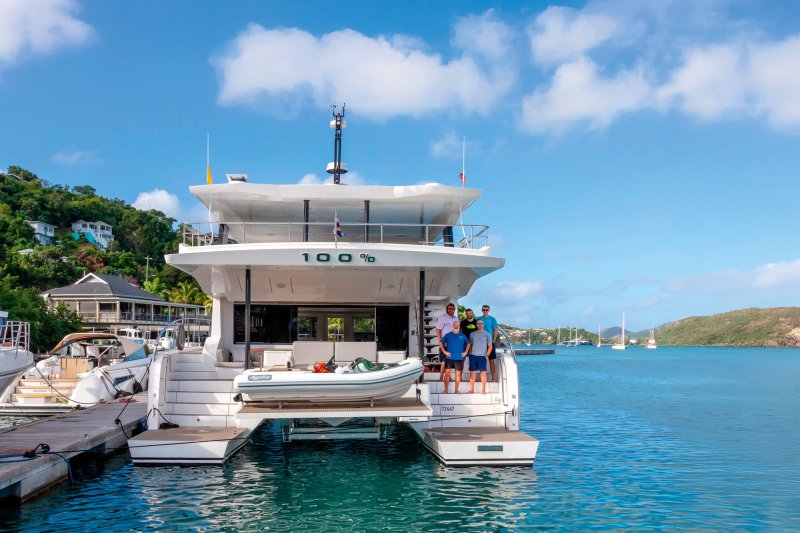
Those figures, Bell says, demonstrate how far solar-electric technology has come, even though some people still question why yachts this size can’t yet run on solar and batteries alone. “Someone asked me, ‘Why do you have to run the generator?’” he says. “We have 42 solar panels on our yacht. We would have to tow over 200 to do solar alone. We crossed the Atlantic, and 72 percent of the time, we were on solar and batteries, and the generator was running for 28 percent of the time. It’s dark for 50 percent of the time we’re out there.”
Bell says he thinks it will take at least a few years before anyone breaks any boundaries with solar-electric efficiencies. The technology simply isn’t advancing that quickly. “You have to charge the batteries by the sun, so you have the limitation of the efficiency of the solar panels,” he says. “It doesn’t matter how big the batteries are. They’re going to need recharging on a five-week crossing. So you need the solar efficiency and maybe the ability to charge the batteries quicker.”
However, he notes, a transatlantic crossing is not the typical use case for an SY62. Most people don’t traverse oceans; they cruise from bay to bay, which means distances where the generator often doesn’t have to turn on at all.

“Consider a trip we did in the Bahamas, from the Exumas up to New Providence,” he says. “We had five days, running about 30 miles, three or four hours of cruising a day. We never ran the generator. If you have no job and you have the luxury where you can just go cruising, then you manage it like an off-grid house. It’s a huge opportunity for people who want to cruise efficiently.”
And, he says, those owners can do a circumnavigation if they wish to go the distance. Bell talks about the Oyster World Rally and the capabilities of Nordhavn motoryachts when he describes the opportunities the SY62 affords. “I’d love to go through Panama, go down to the Galapagos and over to Fiji—you could do that,” he says. “Passagemaking and ocean cruising is a different breed, and it can absolutely be done. We can design the 62 with bigger fuel tanks. Add a second fuel tank or another generator. This is a very different yacht that’s capable of doing expeditions.”
Daily Needs
The Silent 62 has daily consumption of 350 to 600 kWh, depending on how fast the yacht is going. With this transatlantic crossing, the shipyard’s team wanted to demonstrate that those needs can be met, as well as document all kinds of data that is being analyzed to provide insights into solar-electric ocean cruising under real-world conditions.
Silent 62
The shipyard’s order book for Silent 62s is full for the rest of this year and into early next year. From start to finish, construction takes about 12 months. Chairman Steve Bell says: “If you consider a 12-month lead time for a 62, that includes being semicustom on the interior. Maybe you want a full owner’s cabin on one side, or five cabins, or the galley below, along with your choice of materials and finishes.”
57% Higher Speed
The first leg of the trip, at 475 nautical miles, saw the Silent 62 outrunning weather. Average speed was higher than on other legs, at 7.1 knots. Battery propulsion for this leg was 57 percent of travel time, with generator use during 43 percent of the time.
65% Wind and Swell
On the leg from Morocco to the Canary Islands, the crew faced strong headwinds and swell. Across this 253 nautical miles, battery propulsion was 65 percent of the time, with generator run time at 35 percent. Average speed was 6.1 knots on this leg of the trip.
77% On the Currents
The longest leg was 2,110 nautical miles from Cape Verde to Antigua, with 15 knots of wind on the stern and equatorial currents. The yacht had battery propulsion 77 percent of the time, with generator time at 23 percent. Average speed was 6.1 knots.
Take the next step: silent-yachts.com