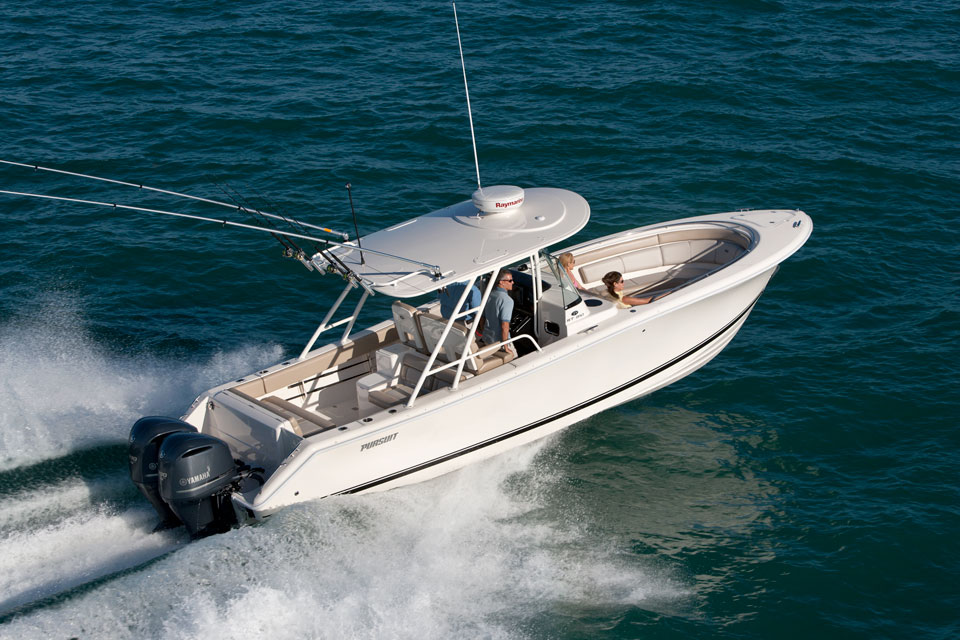
Pursuit Sport Tender 310 Main
I remember when center-console designs began to catch on in the early 1970s. Our family’s first was a 20-footer — about average for the time. It was a Swiss Army knife of boats — perfect for fishing, diving or simply sunset cruising. By the 1990s, towed center consoles were replacing traditional tenders as yachts grew larger and owners longed to remain close to the water. Now it’s common to see boats like Pursuit’s new ST 310 on a leash following the lead of a large motoryacht. This is the market Pursuit had in mind when it penned the ST (Sport Tender) 310.
As center consoles go, the 310 falls into what I consider a sweet spot for the breed, since it needs no more than two stout outboards to deliver first-rate performance. When it comes to outboards, size really does matter. Powering a planing boat with just enough horsepower can result in false economy, since smaller motors must work harder at higher rpm and may burn more fuel. Numbers matter as well. Two of anything mechanical usually lends to redundancy — a plan B. Three of anything mechanical leads to more expense and complication. What’s more, transmitting horsepower through a third lower unit adds drag and reduces efficiency. Ergo, the 310’s size is perfect for a twin-engine application.
Pursuit’s choice of Yamaha F300s is also right on target. These 4.2-liter four-stroke V-6s have the muscle to power the 310 at performance-boat speeds; however, at wiser throttle settings they are relatively efficient. I measured a top speed of 47.4 knots at full throttle, and the Yamaha electronics indicated a burn of 52.4 gallons per hour. I recorded 26.8 knots at 3500 rpm and a fuel burn of 16 gallons per hour — not bad for an 8,890-pound (dry) ride. According to Pursuit’s data, cruising at about this speed is optimum for the 310 and should yield 1.71 miles per gallon or a range of 400 miles from its 260-gallon fuel capacity. This is more than enough to wander the Bahamas without visiting every fuel depot.
I collected our data on the St. Lucie River in Stuart, Florida. While the conditions were not challenging, there was enough wind and chop to gain a feel for the 310’s ride. When easing it ahead it begins to transition to a plane at about 2500 rpm, exhibiting a modest degree of bow rise — Pursuit’s numbers suggest a maximum of six degrees. If you put the throttles down hard it gets up and goes with dispatch. I noted maximum rpm in less than 15 seconds. At speed, it runs cleanly, and its trim angle of 1.5 degrees is perfect. The 310 has a steady track, and helm input is precise. I would opt to mount the Yamaha instrument display on the dash, instead of the overhead; it’s easier on the neck.
_See a complete photo gallery here._
While the term deep-V is a popular marketing tool, the 310’s 24-degree transom deadrise is the real deal. Marketing director David Glenn recently delivered a 310 to a new owner in the Bahamas. The trip included a single day’s run of 185 miles from Fort Pierce, Florida, to Chub Cay, Bahamas. On the first 83-mile leg, Glenn crossed the Gulf Stream to West End, averaging about 28 knots in seas of two to four feet and 15-knot winds — typical crossing weather. After clearing customs he pushed on to Chub, holding his speed in beam seas of four to six feet. Including the break in West End for paperwork, the trip took nine hours.
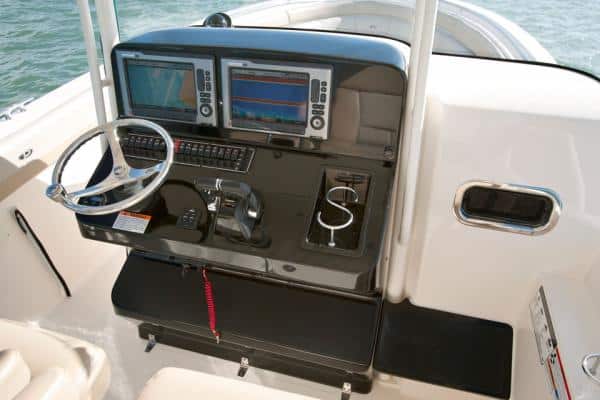
The 310 has the sort of features that folks expect in a high-end center console. Its adjustable helm and dual companion seating provide good visibility and comfort, and its console has plenty of space for big-screen electronics. Our test boat’s acrylic windscreen provided good protection; however, safety glass is now standard — an improvement. Its cockpit area has aft-facing bench seating, a refrigerator and an insulated cooler. A tackle center, a livewell, a cutting board and a sink are designed into the neatly molded cabinetwork. A fish box in the sole is plumbed with a macerator and drains overboard. The transom bench seat has a 39-gallon removable liner that drains overboard.
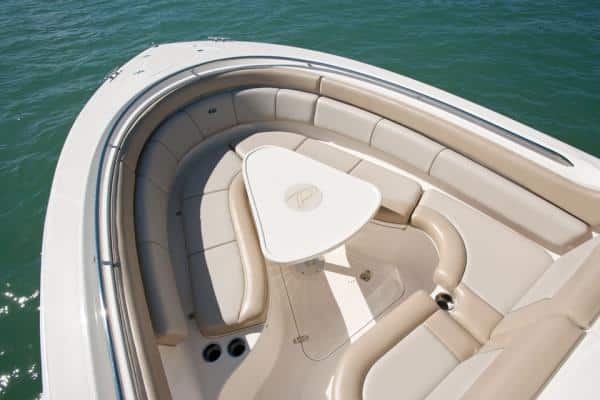
Forward, a door in the console allows access to a fixed marine sanitation device that is plumbed to a 20-gallon holding tank. A 20-gallon freshwater tank feeds the head’s sink/shower and the cockpit sink. A seating area forward of the console is arranged around a table/sun pad insert that can be stowed out of the way in the console. There is rod stowage under the forward seating. A tidy anchor and windlass system are hidden in the bow and accessed through a foredeck hatch. The 310 is topped off with a powder-coated aluminum and fiberglass hardtop with integral lighting — very nice!
Although the 310’s layout and features are fairly typical, it is distinct. You can see and feel the difference in the detail. The interior of the livewell, for example, has LED lighting and is finished in a fish-friendly oceania blue. Its one-piece resin-infused stringer and web-frame system not only lends to its strength but also complements the finished appearance of its bilges.
The 310 is priced at $229,810, which includes a stylish hardtop and a pair of 300-horsepower Yamahas. The short option list has a variety of gelcoat hull colors and a towing package with a tow eye and a soft rub rail.
To focus solely on the 310’s application as a yacht tender would be a mistake, since it is quite capable on its own, without a tow line. For those moving up or down in the market, it would be a great choice for fishing hands-on offshore, running to the islands or simply taking a sunset cruise. It is a perfect Swiss Army knife of a ride!
_See a complete photo gallery here._
Test Conditions: Speeds were measured by GPS in the St. Lucie River in Stuart, Florida, with a light chop and 10 knots of wind, with ½ load of fuel and two people on board. Fuel consumption was calculated from the electronic engine-monitoring system. Sound levels were measured at the helm.
RPM Knots GPH dB(A)
600 3.4 1.2 64
1000 5.6 2.5 69
1500 7.2 4.4 74
2000 7.8 7.5 76
2500 13.0 9.6 82
3000 18.4 13.0 83
3500 26.8 16.0 84
4000 31.6 21.2 87
4500 35.2 28.4 88
5000 41.7 35.7 90
5500 44.4 45.1 92
5900 47.4 52.4 94
LOA: 31’2″
LWL: 26’6″
BEAM: 9’6″
DRAFT: 2’10” (motors down)
DISPL.: 8,890 lb. (dry)
FUEL: 260 gal.
WATER: 20 gal.
TRANSOM DEADRISE: 24 degrees
ENGINE OPTION: 2 x 250 hp Yamaha 4-stroke outboards
ENGINE TESTED: 2 x 300 hp Yamaha 4-stroke outboards
BASE PRICE: $229,810
Pursuit, 772-465-6006; www.pursuitboats.com