Shipshape 1111
Urban legend is the phrase that comes to mind. The owner of a car audio shop sent his best guys — car audio installers — to pimp out his new 40-something express cruiser. Not knowing any better, the pair pulled power for multiple speaker amplifiers from two heavy-cabled isolated power feeds — the circuits for electronic engine controls. As Captain Audio was docking at a dockside watering hole, he cranked his tunes. Those amps sucked power, and the resulting voltage drop locked his engines in neutral. He collided with the dock and other boats, providing far more of a thump than just the deep bass he’d expected.
Urban legend or not, that scenario is completely plausible. Boats have become increasingly dependent upon both electricity and electronics, so ensuring proper work by knowledgeable technicians is more critical today than ever. A good thing for boaters everywhere, the American Boat and Yacht Council and National Marine Electronics Association publish standards for the quality of work and certify the technicians to avoid problems.
So where does one standard leave off and the other begin? “A great example is a VHF radio,” says David Gratton, president of Martek Marine Electronics and current NMEA board chairman. “ABYC gets power to the radio, but NMEA looks at the effective radiated power making it out of the antenna.”
ABYC specifies not more than a 3 percent voltage drop to critical equipment. (Noncritical circuits are allowed 10 percent voltage drop.) NMEA specifies not only proper voltage at the radio when the microphone is keyed, but also the length and diameter of coaxial antenna cable to ensure that no more than 3 decibels of signal are lost from radio to antenna, as well as placement of the antenna.
“We’re both saying the same thing, but for different reasons,” Gratton says. “ABYC says you need a certain size wire for a given length so the wire won’t burn up. NMEA says you need a certain size wire and other things as well so that the radio works the way the manufacturer intended.”
ABYC and NMEA standards are interdependent. ABYC, for example, requires larger wire where it runs through the hot engine rooms or where many wires are bundled together, which increases heat within that bundle. NMEA, on the other hand, looks at those same wire bundles as a source of radio frequency interference.
Marine electronics are becoming less prone to such interference — one example is an improvement in the filtering of depth sounder transducers — but this isn’t true of residential entertainment equipment. Had Captain Audio’s boys distributed satellite television signals around the boat, for example, he would likely have had signal problems if those wires had been run alongside 120-volt AC power conductors. An installer who had been certified by the NMEA would have understood the situation and avoided such issues.
For the most part, the NMEA builds upon ABYC standards. “NMEA says DC wires must have overcurrent protection, but ABYC devotes a lot more attention to DC overcurrent protection,” says Ward Eshleman, president of Ward’s Marine Electric in Fort Lauderdale, Florida. He also helps write ABYC electrical standards, which detail circuit breakers or fuses, not just to protect equipment but also to prevent fire and electric shock.
Batteries are an area of divergence. “NMEA says if the total load for electronics is above 10 amps, [those devices] need to have their own battery bank. That’s an excellent requirement. An engine starter causes a significant voltage drop,” Eshleman says, which may power off electronics when you need them the most. “Then the swing back the other way causes transient voltage spikes that can damage electronic components.” Separate electronics batteries and engine batteries avoid those problems, but Eshleman says, “ABYC doesn’t say you have to have separate battery banks for engine starting, house current and electronics. If they are installed, ABYC specifies the switching, overcurrent protection and wire size.”
The NMEA also specifies the minimum amount of reserve battery capacity for electronics, backup batteries for electronics in case of flooding in the engine room, and charging capacity for those batteries. The ABYC, on the other hand, specifies a less-stringent minimum reserve for batteries incorporating all the ship’s systems.
There are places the two standards don’t agree. For example, the NMEA allows smaller-size wires between electronic components than the ABYC allows anywhere aboard. And there are reasons to abandon either standard. (Both sets of standards are recommendations, not law.) “NMEA isn’t necessarily the only solution,” says Skip Burdon, president of ABYC. He points to ISO and various class certifications that may employ different specs than either NMEA or ABYC. Engine manufacturers often insist upon their own way of wiring, as well as their own intercommunication protocols. “They don’t necessarily want to have outside electronics sending information into their engines,” Burdon says.
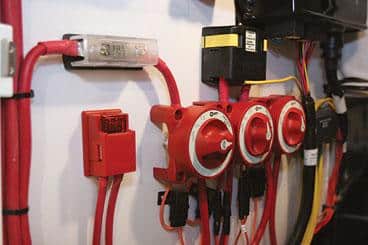
The ABYC and NMEA standards promote expert work.
Today, electricity is replacing mechanical systems in engines, transmissions and steering. At the same time, joystick maneuvering requires input from GPS and an electronic compass. “More and more of our work is with electronic equipment,” Eshleman says. “Touchscreen controls, seamless power transfer — we’re heavily involved in electronics, just not navigation and communication. We’re using electronics to control electrical equipment.”
Boatbuilders and contractors are also becoming more sophisticated. Eshleman notes places where today’s industry practices are more stringent than ABYC’s. For example, Ward’s and most similar companies contain electrical panels and junctions within metallic housings, so heat or sparks from a loose wire will trip a circuit breaker before starting a fire. ABYC still allows wooden enclosures.
Eshleman also points to seamless power transfer from generator to shore, or paralleling multiple generators to meet demand. Any such intermingling of AC power sources is actually prohibited by ABYC, although Eshleman expects new ABYC standards addressing AC power soon.
In short, ABYC ensures safe power to all ship systems, not just to electronics but engines, lighting and even air-conditioners and the clothes dryer. NMEA relies on ABYC for the basic infrastructure and then builds upon it to ensure that electronics function well. ABYC also relies upon NMEA standards so electronics don’t interfere with other ship systems. Both organizations assume future work is done by technicians who understand and follow those rules.
So if a fellow yachtsman on your dock is contemplating, say, a new sound system from installers without NMEA certification, mention the legend of Captain Audio.