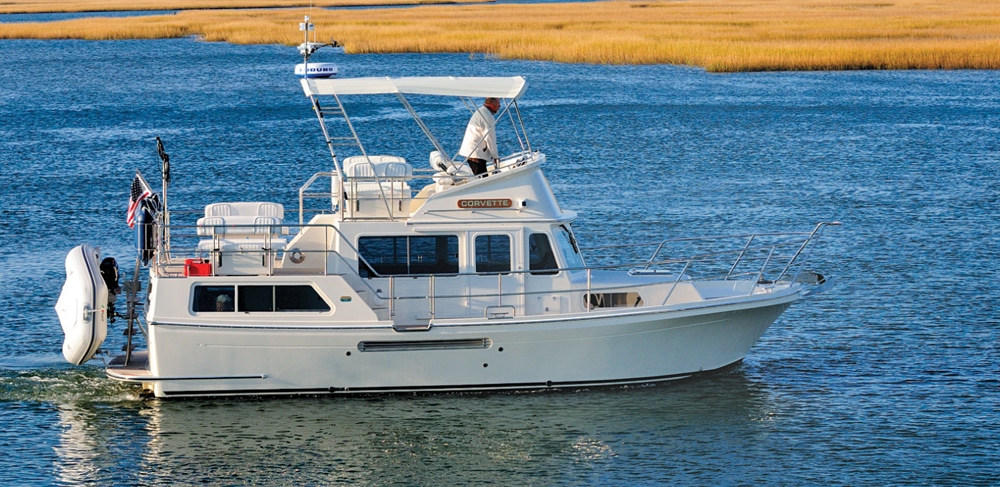
Doing the Ditch
Sitting in the salon having my morning coffee, I heard a knock from outside and saw the owner of a nearby trawler standing on the dock, charts in hand, eager to talk with me. He’d heard I was headed south and was wondering what I knew about Georgia’s Hell Gate, an increasingly tricky spot to get through on the Intracoastal Waterway (ICW).
Other ICW travelers soon joined us as the sun rose on Georgia’s Isle of Hope Marina. Double-checking tide tables and sharing local knowledge had become a necessity during this trip, especially in Georgia, where the Feds’ dredging hasn’t kept up with the constant shoaling.
I hadn’t traveled “The Ditch” since 2003 and was eager to know if the rumors about severe shoaling were true. My boat for this 1,200-mile trip from Annapolis, Maryland, to Stuart, Florida, was ideal. The twin-engine Corvette 340 cruises at 18 knots and draws only 3 feet 3 inches, and her props and shafts are protected by a keel.
The builder of this new model, who also builds Fleming Yachts, asked me to deliver it for Florida’s winter boat shows and to provide feedback about its performance and design details before they ramped up production. I can’t think of a more thorough sea trial than a two-week journey down the Atlantic Intracoastal Waterway.
Part One: Annapolis to Beaufort, South Carolina
The trip began in early November with a 150-mile, nonstop run down the Chesapeake Bay from Annapolis to Portsmouth, Virginia. Joining me for the first leg was my boating buddy from Canada, Pat Horvat, who was eager to leave Alberta’s minus 20 degree weather behind him. Cruising at 18 knots we arrived at the Tidewater Marina in Portsmouth in 8ø hours. At this speed the Corvette’s Cummins 330s burn 23 gallons per hour.
A boardwalk with planned green space lines the restored Portsmouth waterfront, which is across the Elizabeth River from Norfolk’s popular Nauticus museum and the USS Wisconsin battleship. During rush hour a paddle-wheel ferry delivers commuters to Norfolk’s bustling business section.
Since I’d run the Virginia Cut before, we decided to try the alternative route, the Dismal Swamp, which cuts through a wildlife refuge on its way to Elizabeth City, North Carolina. It was a weekday morning, so we had to plan for the restricted opening of the nearby Gilmerton Bridge as well as Deep Creek Lock, the first of two easy-to-transit locks along the route. Although we were only 55 miles from Elizabeth City, the speed limit between locks meant we would be pushing it to get there before dark.
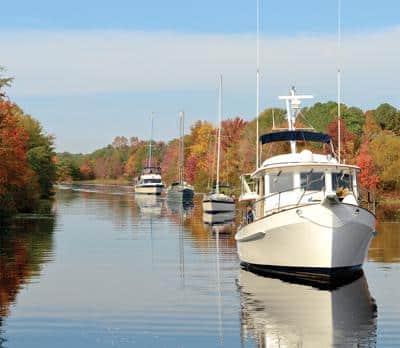
The scenery was spectacular, but we kept our eyes ahead of us, since half- submerged tree branches and logs threatened our props. Using extreme caution and running at 6 knots didn’t prevent the repeated bumps and bangs from rattling our nerves. No wonder sailboats and displacement trawlers with protected running gear tend to favor this route.
We found Mariner’s Wharf, a row of complimentary transient slips in downtown Elizabeth City, as the last light dipped below the cityscape. Dubbed the “Harbor of Hospitality,” Elizabeth City encourages boaters to stop here, and its revitalized waterfront, shops, restaurants and Museum of the Albemarle are good reasons to do so.
Our next stop was Belhaven, North Carolina, 85 miles south. A nasty chop on the Albemarle Sound showed the Corvette’s rough water pedigree, and our cruising speed remained a comfortable 18 knots except for no-wake zones. After getting a slip at the accommodating Belhaven Waterway Marina, a walk through town revealed a struggling local economy.
We found a more vibrant atmosphere 50 miles south at Oriental. Known as “The Sailing Capital of the Carolinas,” Oriental is a small, quiet town located on the Neuse River off Pamlico Sound, a large estuary second in size to the Chesapeake Bay. Cruising, sailing and fishing are an integral part of the area’s culture, and the town enthusiastically welcomes transients.
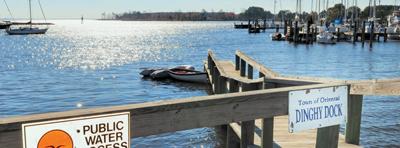
Our slip at the Oriental Marina and Inn was convenient to its Tiki Bar and Restaurant, where we enjoyed happy hour and an excellent meal. A public dinghy dock encourages anchoring in the small harbor or up Greens Creek, just beyond the 45-foot-high bridge. Besides boating activities, Oriental seems to inspire healthy doses of walking and talking. My morning stroll along the river’s Lou Mac Park was followed by breakfast at The Bean, where locals gather to discuss sports and politics, all with a dash of good ol’ boy, Southern humor.
Weather permitting, running outside can save hours, so after arriving in Beaufort, North Carolina, the next day we made the offshore jump to Wrightsville Beach, also in North Carolina. Both inlets are wide and well marked, and the Corvette ran them effortlessly. After getting fuel and an overnight slip at Seapath Yacht Club, we walked to the thriving beach community for dinner. On our two-mile walk, however, one young jogger after another ran by us. It seemed as if the entire town consisted of 20-somethings training for a marathon. Our waitress explained, “Everyone in Wrightsville Beach loves to run before dinner.” What’s this world coming to when running replaces happy hour?
Our route the next morning took us past the sandy shores of Masonboro and Myrtle Grove Sound, where hearty souls were out fishing or walking the beaches in the unseasonably cold weather. The waterway is straight and narrow here, and it’s important to stay in the middle of the marked channel. Temporary buoys, some of which are not on the charts, mark the shoal areas where the ICW crosses side creeks and small inlets.
We stopped for lunch in Southport, North Carolina, near the mouth of the Cape Fear River. The popular Southport Marina, recently renovated, has more than 200 slips and welcomes transients. Getting a transient slip here turned into an amusing experience. The dockmaster gave us directions, telling us to “turn left” after entering. We soon found ourselves on the wrong side of the marina. After eventually finding our way, we listened as he misdirected the next several boats behind us. Unfortunately, he hadn’t realized “his left” looking out from the marina was “our right” looking in. The confusing radio chatter between the arriving boats and the dockmaster was hilarious.
Southport is the quintessential Southern town, and it’s easy to think about living here. One of my favorite novels, The Old Man and the Boy, written by Robert Ruark, was based on his childhood years in Southport. The picturesque streets lined with live oaks and historic homes have been the scene of several television shows and movies including Dawson’s Creek and Crimes of the Heart.
Headed to Charleston, South Carolina, the next morning, we considered running outside from Georgetown, but because of an opposing tide and wind in the inlet, we stayed inside, running the 120 miles in nine hours. The Ashley Marina, just outside of downtown Charleston, had transient space between a couple of 100-footers, and we carefully maneuvered the beamy Corvette between them, very aware of the 2-knot river current.
A short taxi ride delivered us to the center of town, packed with a Saturday night crowd of locals, tourists and cruise ship passengers. Charleston is a Southern gem, offering restaurants, shops and entertainment for everyone. Above all, it is a beautiful city, and a walk along The Battery with its antebellum mansions and cobblestone streets is a must.
Our final destination for this leg was Beaufort, South Carolina, 65 miles south. This section of the ICW is attractive and easy to navigate, as it wanders through natural salt marshes known as the Low Country. While some shoaling exists, staying in the middle of the mostly wide channels kept us in deep water.
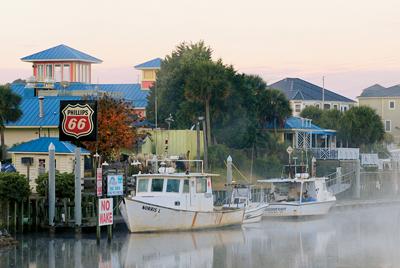
We left the Corvette at Beaufort’s Downtown Marina and headed home for Thanksgiving. Covering 700 miles in eight days, we didn’t spend much time at any one stopover, but we did get a chance to see what each had to offer. Navigating this half of the ICW is simple and straightforward, and with more time and warmer weather, it could easily qualify as a fun vacation cruise.
The same cannot be said for the rest of the ICW’s tricky route to Stuart, Florida. Look for Part Two of my article, on navigating the more challenging legs of this journey south, in the Cruising Yachtsman section of Yachting‘s June issue.
Click here to read Doing the Ditch, Part II
The Corvette 340
A little yacht with big ambitions.
The all-new Corvette 340 is an updated version of Europe’s popular Corvette 320, and it is now built at the same yard in Taiwan where Fleming motoryachts are built. Marketed as “The World’s Biggest Little Yacht” it offers two private staterooms, each with a head and shower. The aft stateroom is impressive, as it utilizes the full width of the hull and features a walk-around island berth, a large hanging locker, built-in dressers and a desk/vanity. Outside, there are two spacious living areas, the aft sundeck as well as the flying bridge, which seats seven.
Beyond its generous living space, the Corvette 340 delivers superb performance and quality. Even with the standard Yanmar 315 horsepower engines, she will cruise at 18 knots and top out at more than 20 knots. The factory is working on other power packages in addition to the optional Cummins, which are a bit large for this engine room. A lot of attention has been paid to noise attenuation, and running this boat for 8 or 9 hours a day is not at all tiring because it is so quiet, especially when at the upper helm. With its twin screws, the 340 is extremely easy to maneuver, even without the use of its bow thruster.
In ocean swells, running an inlet or heading directly into a nasty chop, the Corvette’s proven hull design works well and provides a sense of confidence even in snotty conditions. It doesn’t pound or slam into head seas, and in following seas it tracks well and is very much in control (a bit surprising considering its rather square, boxy rear end).
If you have ever been on a Fleming yacht, you will recognize the quality of the Corvette’s systems engineering as well as its interior woodwork. It is apparent these craftsmen don’t know how to build anything other than a first class yacht, even if it’s only 34-feet in length. The flawless gelcoat, teak decks (vacuum bagged to the fiberglass decks eliminating the need for fasteners) and heavy-duty stainless rails and hardware are just a few signs that this is a well-built yacht which will hold its value for many years.
A few things on this new model need to be tweaked, however, and the factory has already responded with new drawings. The second helm chair crowds the salon and is in the way of the electrical panel, so both helm chairs are being replaced by a convertible bench seat that will also extend the settee. Access to the engine room will also be improved with different sized hatches and an easily removable salon table. Otherwise, I found this updated version of its popular predecessor to be a well designed, solidly built yacht.
Certainly the Corvette 340 is not an inexpensive 34-foot boat, but upon close inspection, you get what you pay for. It’s ideal for those downsizing from a larger yacht who don’t want to sacrifice quality or luxury, and it would be a significant upgrade for those graduating from a smaller boat and/or lesser brand. For more information and dealer listings, visit www.corvettemarine.com.
Specifications
LOA: 34’10”
Beam: 13′
Draft: 3’3″
Displ.: 23,148 lbs.
Fuel: 290 USG
Water: 135 USG
Standard Power: Twin Yanmar 6LP 315 hp Diesels
Optional Power: Twin Cummins QSB 330 hp or Volvo D6 330-hp
Base Price: $415,000
As Tested: $500,000
Performance
RPM KNOTS GPH DbA
600 4.5 .8 62
1250 7.5 5 68
1500 9 6.5 74
2000 12 18 78
2400 18 23 82
3000 24 34 86
Tested with optional Cummins engines. Sound measured in main salon. Conditions were in one-foot seas with 3/4 fuel and water and two people onboard.
ICW Itinerary
Much of the ICW route has narrow, No-Wake Zones, passing by marinas, homes with docks and small boats fishing the shoreline. Being able to get up and cruise at 18-knots where possible was a big advantage.
Leg ** **Miles Hours
Annapolis-Portsmouth 150 8.25
Portsmouth-Elizabeth City 55 7
Elizabeth City-Belhaven 84 6.25
Belhaven-Oriental 47 4
Oriental-Wrightsville Beach* 101 6
Wrightsville Beach-N.Myrtle Beach** 65 8
N.Myrtle Beach-Charleston 122 9
Charleston-Beaufort 66 5
Beaufort-Isle of Hope 55 5
Isle of Hope-Brunswick 95 7.5
Brunswick-Fernandina Beach 40 3
Fernandina Beach-St. Augustine 60 6
St. Augustine-New Smyrna Beach 69 6
New Smyrna Beach-Melbourne 70 6
Melbourne-Stuart 70 5.5
**Totals:** 1149 92.5
_* Ran outside from Beaufort, NC to Wrightsville Beach
** Stopped for 2 1/5 hours in Southport__
_