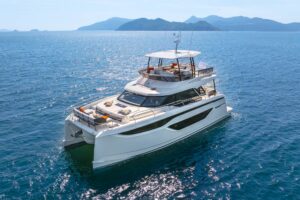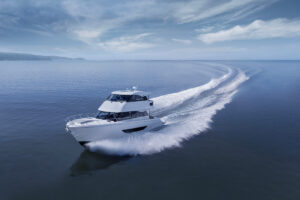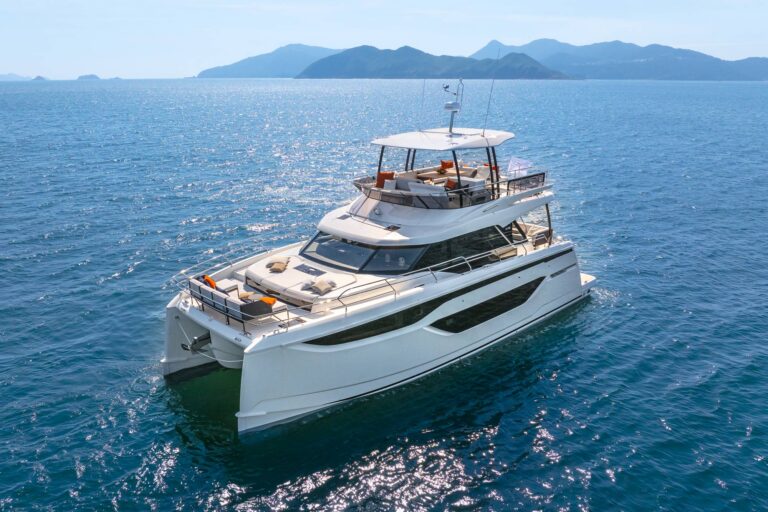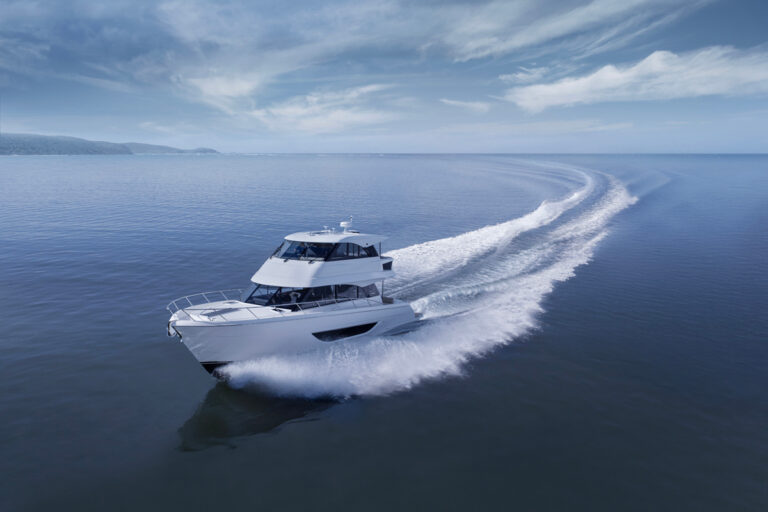

The Prestige F4.3 is the latest and smallest vessel in the builder’s reimagined F-Line series, which has anchored the brand’s flybridge offerings for more than two decades. At just shy of 43 feet length overall, it inherits the hull form and lower-deck arrangement of its predecessor, the F420, yet its personality and amenities signal a significant step forward in comfort, social flow and European style.
Prestige Yachts traces its heritage to the Jeanneau shipyard in Les Herbiers, France, where fiberglass pleasure craft were built as early as 1957. The Prestige brand emerged in 1989 with the launch of the Prestige 41, an express cruiser created in collaboration with Italy’s Garroni Design studio. This Franco-Italian partnership, with its blend of engineering discipline and Mediterranean style, still defines Prestige today.
In 2000, Prestige entered the flybridge market with the original F-Line, bringing light-filled interiors and family-friendly layouts to yachts in the 40- to 60-foot range. Over the years, the lineup expanded to include the sport-oriented S-Line, the wide-body X-Line and the long-range multihull M-Line, each reflecting a balance of innovation and tradition.

Production now takes place in Les Herbiers and in Monfalcone, Italy, with more than 5,000 yachts delivered worldwide. Prestige’s goal remains consistent: creating boats that combine elegance, practicality and approachable, reliable handling. Those qualities have earned the brand a loyal following from Europe to North America and well beyond.
The transformation in the builder’s latest offering is perhaps clearest on the main deck. Here, Prestige’s new OceanView galley—a beam-wide cooking and prep space flanked by wide sliding doors and a gas-strut opening aft window measuring 62 by 32 inches—breaks from the more contained galley layouts of the earlier F420 and F430. The result is a three-sided connection to the outdoors. The openness makes entertaining effortless, as guests can pass dishes to the cockpit or flybridge without breaking stride, keeping the chef part of the action rather than out of sight. By removing those physical and visual barriers, Prestige has turned the galley from a tucked-away necessity into the yacht’s social center.
Interestingly, there’s no grill or cooktop on the flybridge. Based on client feedback, Prestige realized there was a preference for using the galley instead, information that also contributed to decision-making on the redesign.

The cockpit also adds some refinements. The F4.3 has a convertible table/sun pad and improves the connection to the swim platform, which is now hydraulic. Here, a wet-bar arrangement is reminiscent of the F450’s party-friendly transom, bringing an upscale touch to a smaller footprint.
Belowdecks, the F4.3 retains the family-friendly two-stateroom, two-head layout, with a full-beam owner’s suite located amidships and the VIP forward. Buyers can opt for a utility space instead of a second en suite, mirroring the customizable flexibility seen in larger Prestige models.
The flybridge is really the beating heart of the F4.3. There’s a single helm seat for the skipper and a chaise for passengers to enjoy the view, while the after section adds more seating. The flybridge retains the social intent of its bigger sisterships but grows in usable space and flexibility. U-shape seating, a forward sun pad, a tucked-away fridge and the choice of a Bimini top or a fixed hardtop make the boat a versatile platform. Compared with earlier models, there’s more emphasis on blending lounging and dining areas.

Performance stays true to the F-Line’s DNA. Twin 440 hp Volvo Penta D6s with V-drives are the power package of choice for the builder. It’s hard to beat that wind-in-your-hair feeling of running a well-built vessel from the flybridge, and the F4.3 certainly didn’t disappoint in that regard. Handling was sportscar-tight as we roared along the Gulf of Trieste just outside Portopiccolo, Italy, in breezy, slightly choppy conditions.
At 21 knots, the diesels burned just 30 gallons per hour, a tribute to the efficiency of the hull design. Bumping the throttles up to 25 knots increased fuel burn slightly to 32 gph, a speed that I felt was ideal for covering ground while keeping everyone on board comfortable in the conditions. A glance at the Garmin multifunction displays verified a range of 217 nautical miles at that speed with a 10 percent fuel reserve, more than enough for a vessel that is a dayboat at heart. At full throttle, the Volvo Pentas produced a top speed of just over 30 knots at 3,500 rpm. The Zipwake Pro system helped keep the F4.3 running at the correct attitude throughout our time aboard, automatically controlling the trim and bow angle— even in the sharpest of maneuvers. The joystick handling, in coordination with the Side-Power bow thruster, helped us slide easily into a tight Med-style mooring between much larger yachts back at the marina.
Prestige has always aimed to balance European styling with practical cruising needs. In the F4.3, that philosophy is expressed in small but telling ways. There’s a cockpit arranged for dining and lounging, stowage tucked away yet right where owners need it, and a galley that doesn’t isolate the chef from the party. These refinements may seem subtle, but together they make the F4.3 a clear next step in the F-Line’s evolution. It’s proof that even in a smaller-size package, Prestige can still raise the bar for flybridge living.

V for Velocity
The F4.3 runs on twin 440 hp Volvo Penta D6 diesel engines paired to V-drive shafts. Each inline six displaces 5.5 liters and delivers smooth acceleration throughout the power curve. The V-drives keep the engines low and aft in the hull, adding space for the full-beam owner’s stateroom and simplifying the running gear.
Designer’s Touch
Italy’s Garroni Design has been at the heart of Prestige styling since the brand’s inception in 1989. Prestige’s blend of sculpted exterior lines, sweeping window profiles and user-centric interiors is on full display in the F4.3. Garroni’s fingerprints appear in the balance of symmetry and asymmetry, including the angled cabinetry, offset staircases and diagonally grained woods, all working together to create the sense of a larger yacht.
Take the next step: prestige-yachts.com