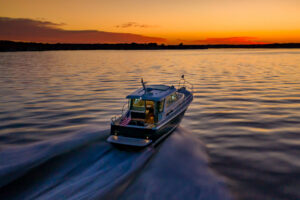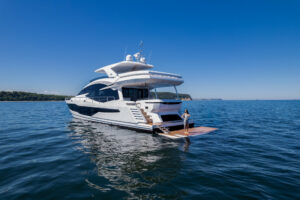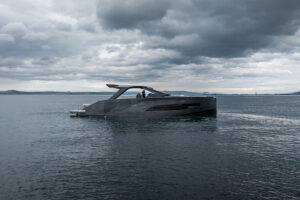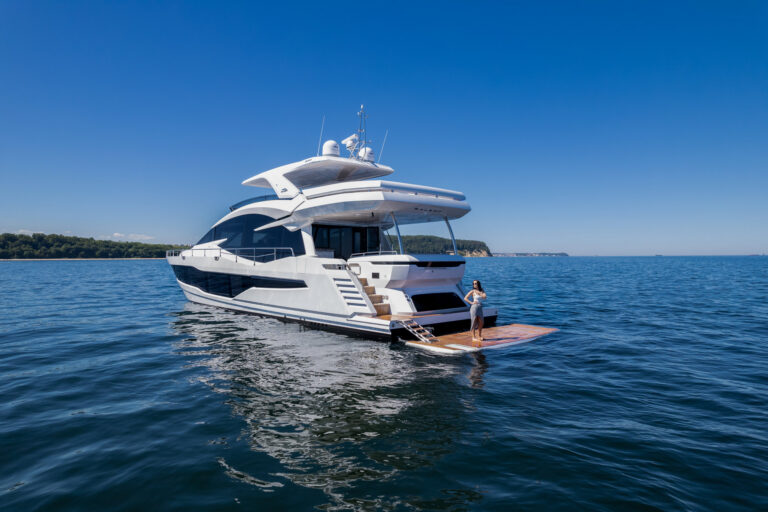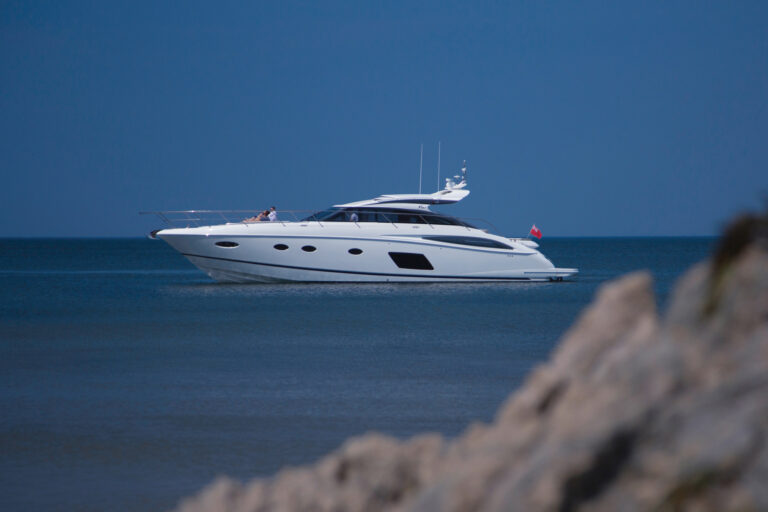
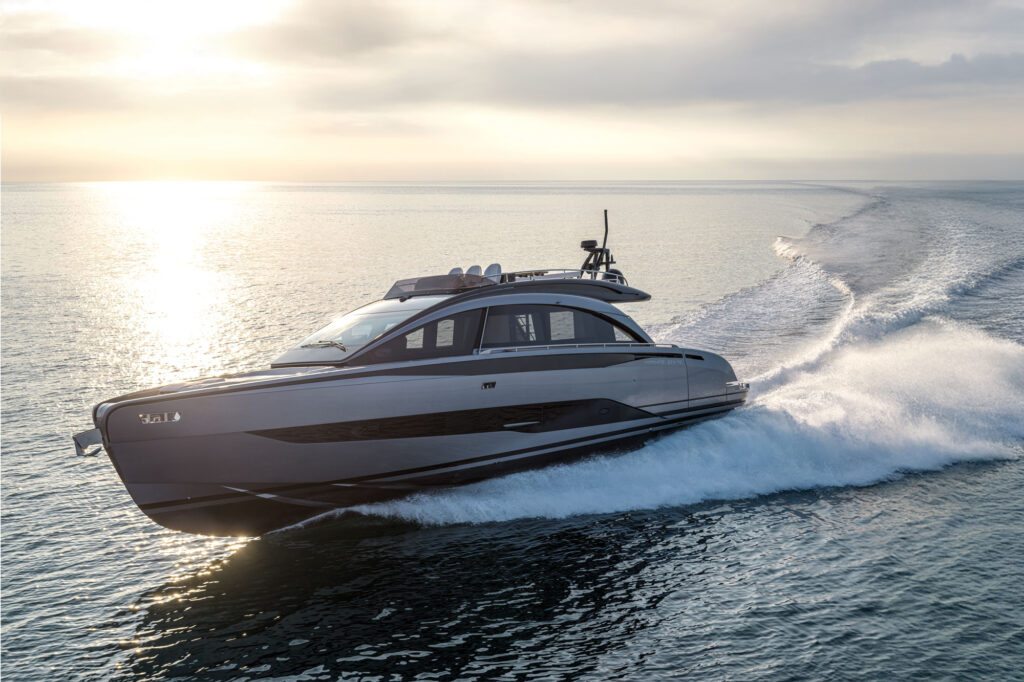
Pershing’s GTX models are its SUVs. They have a little more volume than Pershing’s X design, and they are a bit less ferocious when it comes to performance. As with the automotive origins of a GT designation—gran turismo or grand tourer—these Pershing models are intended to be more comfortable for cruising. They’re about marathons, not sprints.
The GTX70 is the third GTX model, and the second one designed by Michelangelo Vallicelli and his Rome-based studio. Both the GTX70 and GTX80 have triple Volvo Penta IPS installations, instead of the surface drives of their X-model siblings.
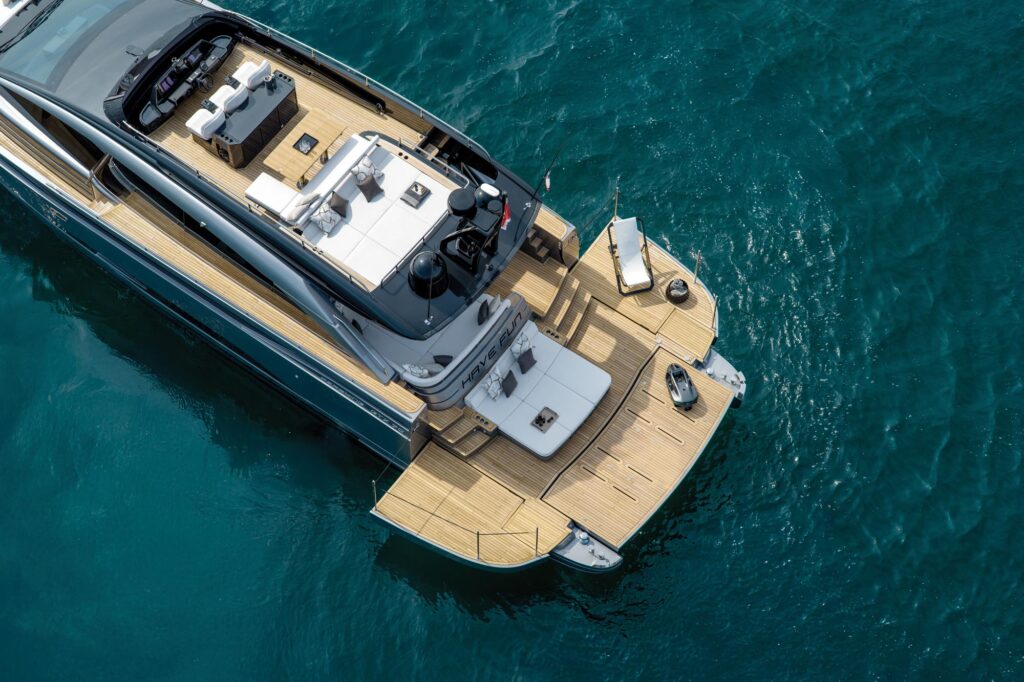
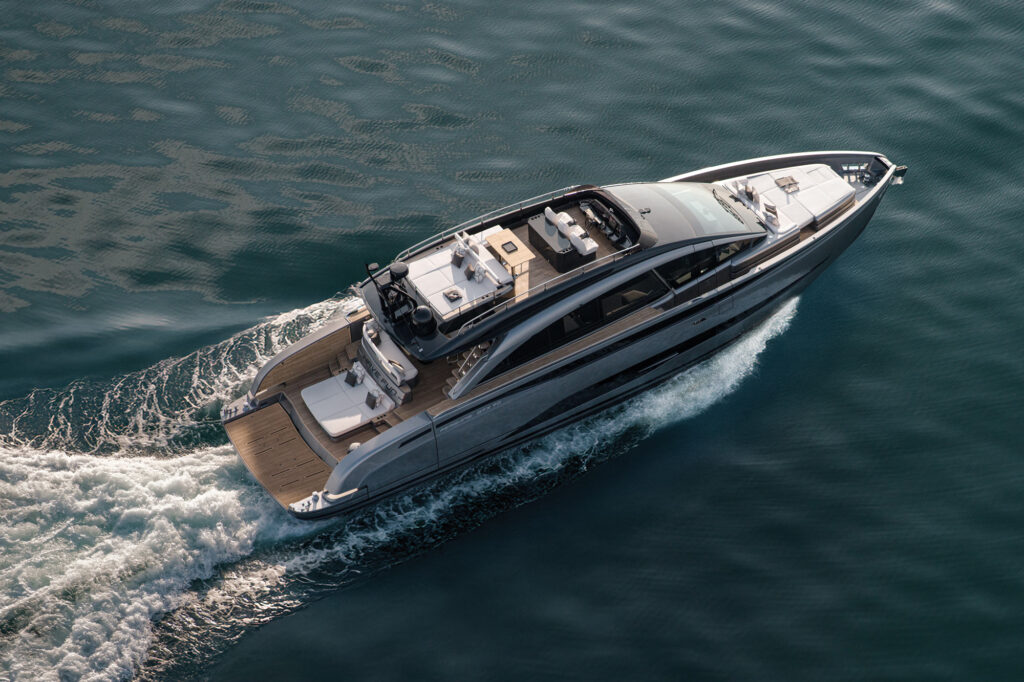
Aboard the GTX70, those triple diesels and pod drives are tucked well aft beneath a two-level cockpit, with a lower after section and swim platform big enough for a jet tender and a PWC to be stowed side by side. The engine room, most of which is beneath the cockpit, feels relatively large thanks to the yacht’s lack of a garage. The beach club has fold-down quarter platforms, while the upper cockpit has built-in furniture: a C-shaped booth and a sun pad.
The GTX70’s side decks maximize the salon real estate. The main route from the cockpit to the foredeck is via the salon. There’s more seating and sun-lounging space on the foredeck, and it’s an asymmetrical layout with starboard-side access only.
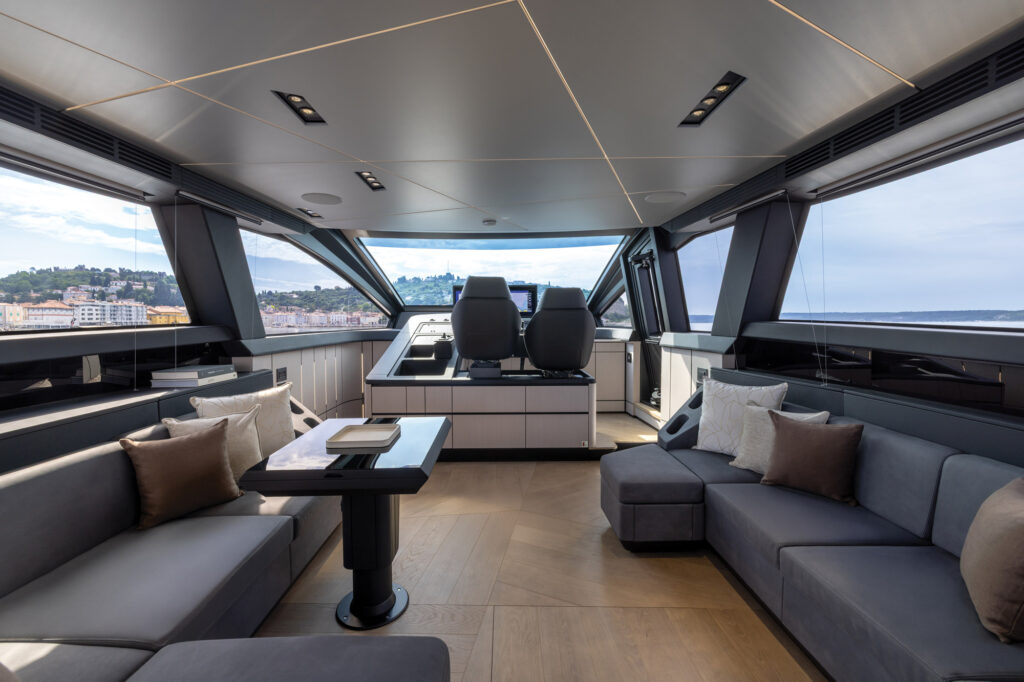
This sports-fly is big enough not only for more sunbathing spots and another L-shaped booth, but also for a row of three bucket seats at the helm. The middle one and the wheel are on the centerline, with the driving experience being an important part of brand cachet.
Inside, there is a galley aft, a lounge amidships with sofas on both sides, and a bridge area that promises exceptional visibility. The U-shape galley and cockpit unite when the glass door to the starboard side of the cockpit is open and the glass window to port is dropped into the countertop.
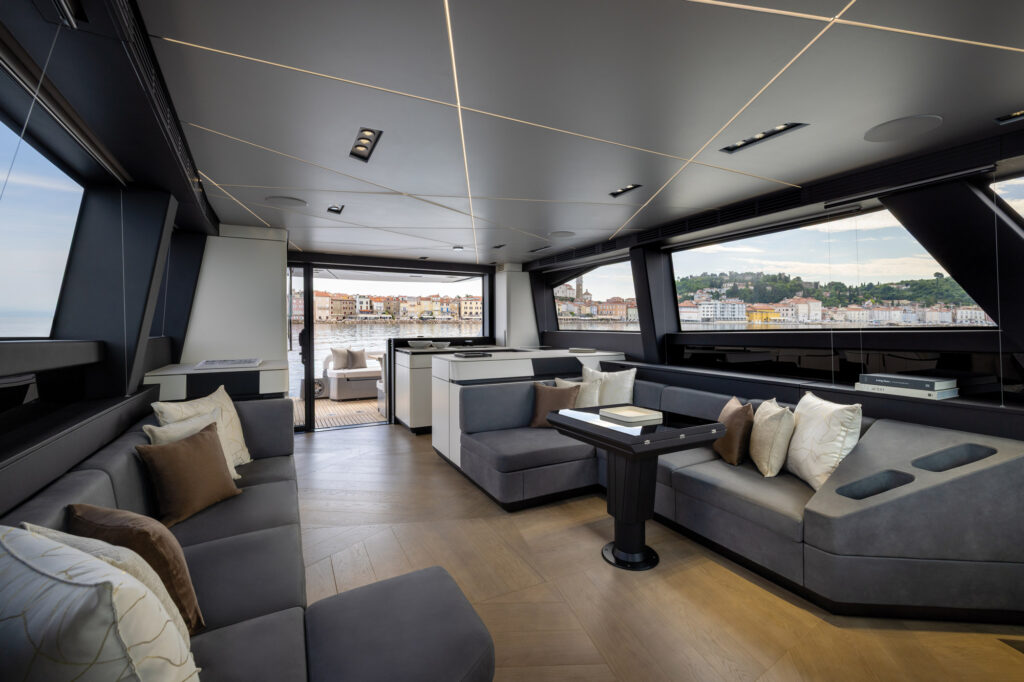
The décor is Italian chic, but with a distinctly masculine flavor: lights and darks, blacks and grays, satins and mattes, oaks and leathers, not to mention enticing glimpses of carbon fiber here and there. Two front seats address a two-screen bridge display. Those two seats are flanked by a side-deck door to starboard that connects to the foredeck. To port of the bridge console, there is a dogleg staircase to the accommodations belowdecks.
Three en suite staterooms include an owner’s stateroom amidships with a side-door entrance from a central companionway. The aft-facing berth is offset slightly to starboard, and hidden from the view of any guests who happen to be in the companionway. A portside sofa makes the most of the hullside window views, while the en suite and walk-in closet serve as a sound buffer from the engine room. I measured decibels here in the 70s at the upper end of the GTX70’s speed range. At a 10-knot cruise, noise levels were below 60 decibels, quieter than normal conversation.
A VIP stateroom is forward with a double berth, and there’s a guest stateroom with twin berths. There’s also a crew cabin in the bow.
Pershing offers two propulsion options: triple 900 hp Volvo Penta D13-IPS1200s as standard, with the option of 1,000 hp D13-IPS1350s. The first three GTX70s, including the one I got aboard, have the standard installation that is quoted at a 36-knot maximum speed. The fourth hull, which is on schedule to deliver early next year to an owner in the Middle East, is expected to have the bigger engines with a top speed closer to 40 knots.

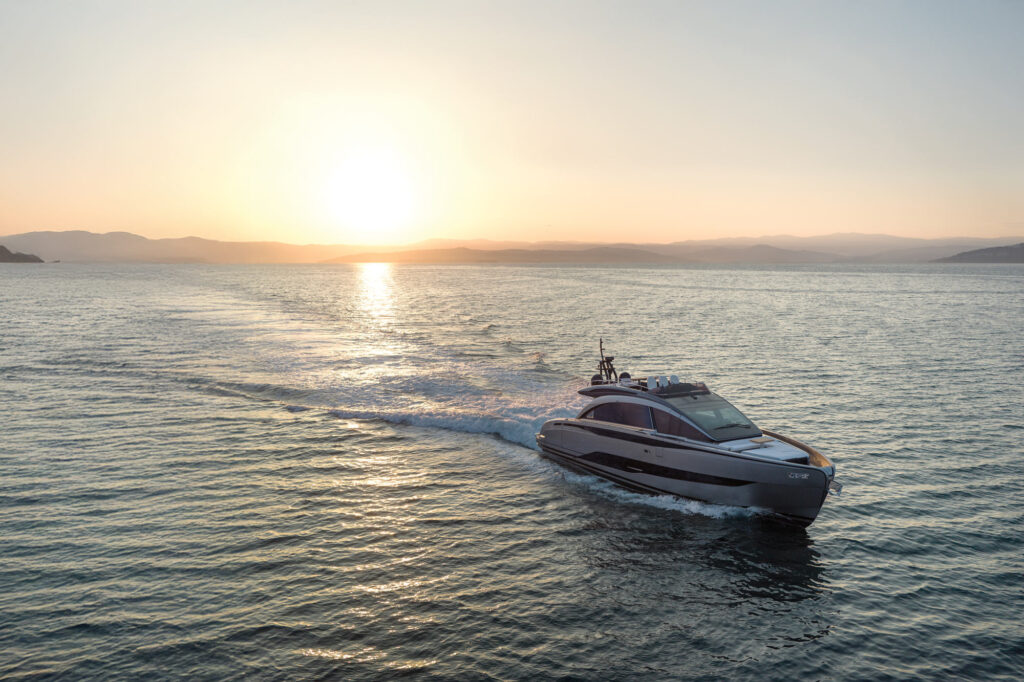
The best speed I saw during my time aboard on a flat-calm Adriatic Sea was 35.5 knots at the rated maximum 2,350 rpm. That was with Trim Assist and the Seakeeper 18 on, and the yacht at close to half-load with 436 gallons of fuel, 177 gallons of water, and 16 people aboard. There was no tender or toys.
Visibility is good forward through the one-piece windshield and to the sides, save for those chunky A-posts. Once the yacht is on plane, views astern are not quite as good, as the bow will typically be up by 3.5 to 4.5 degrees. The turning circle can be quite gentle at speed, which is typical of IPS installations aboard models with upper-helm positions.
Given the yacht’s 1,110-gallon fuel capacity, the ultimate range at 20 to 30 knots is just over 300 nautical miles. Dial it back to 10 knots, and range doubles. The 3.6 to 3.7 gallons of fuel burned per nautical mile stays remarkably flat from 15 to 30 knots.
Overall, the Pershing GTX70 has an eye-catching profile, stylish appointments inside and out, and solid performance. This is a cruiseworthy craft with some panache for good measure.
Life Begins at ’85
The original company behind Pershing was Cantiere Navale dell’Adriatico. It began officially in 1981, but its first Pershing, the 45, didn’t launch until 1985. Since then, around 2,000 Pershings have been delivered, 10 percent of them 80 feet or longer. The brand has been part of the Ferretti Group since 1998.
Something For Everyone
Pershing’s X-range models, from 54 to 92 feet length overall, have 40-knot-plus top speeds. The 70- to 116-foot GTX sports-fly range is built with Volvo Penta IPS propulsion systems. There’s also the all-aluminum Pershing 140, whose fifth hull is on track to be delivered next year. A new flagship design, the Pershing 170, is awaiting its first signed contract.
Made in Italy
Pershing’s headquarters is in Mondolfo, roughly halfway between Ancona and Rimini on Italy’s Adriatic coast. Because of Pershing’s high-performance reputation, Ferretti Group CEO Alberto Galassi has always referred to the location as the yachting industry’s “Top Gun.” All of the X and GTX models are built there. Only the largest aluminum Pershings are built at the Ferretti Group’s Superyacht Division in Ancona.
Take the next step: pershing-yacht.com