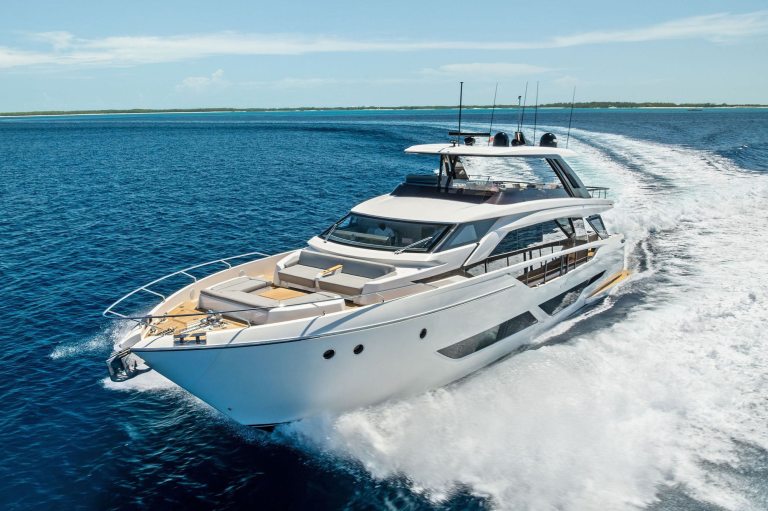
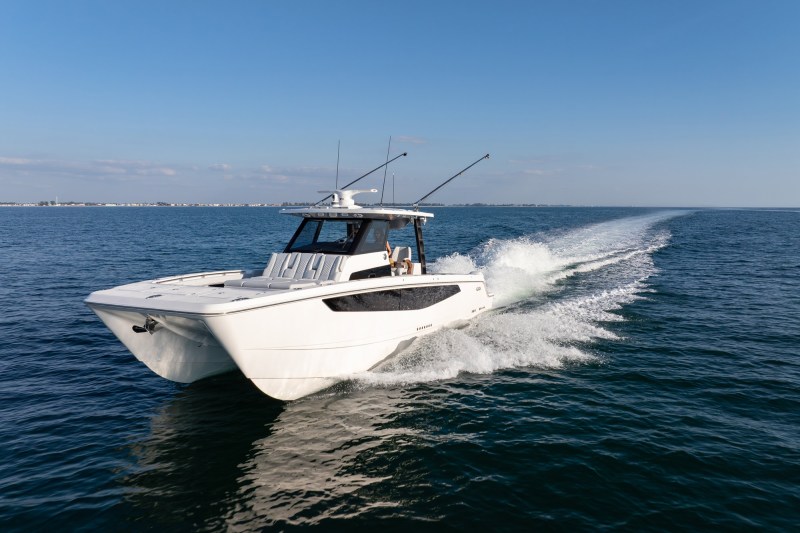
The Aquila 36 Molokai occupies a strategic middle ground in the builder’s offshore fishing lineup, clocking between the 28 and the flagship 47. At first glance, it’s easy to view the 36 as simply another fishing-focused power cat in a rapidly expanding category. But spend time aboard in rough water and it becomes clear that Aquila has brought something more substantial to the table.
The company’s experience building yachts to 70 feet shows throughout this boat, not in decorative flourishes but in the engineering discipline and fit-and-finish. Designed to run far, fish hard and return to the dock safely, the 36 Molokai checks all the boxes. It also introduces a level of systems integration and execution that should appeal to tournament anglers and owners looking for a more polished all-around cruising platform.
Our sea trial off Jupiter, Florida, came in conditions that would test any vessel, much less a 36-footer. A steady 15-knot northeast breeze had stacked the Atlantic into tightly packed, confused 3- to 5-foot whitecaps off a messy shoaling inlet against the outgoing tide. The Aquila never flinched.
One of the advantages of a well-designed catamaran is the ability to soften rough-water impacts while maintaining lateral stability. The 36’s relatively long hulls and tall tunnel help minimize pounding while greatly reducing tunnel slap and the “sneezing” that can plague some twin-hull designs.
Equally impressive was what the boat didn’t do. Some catamarans have an unnerving habit of bow steering when one sponson grabs first in quartering seas, causing the boat to shear unexpectedly to one side. The Aquila tracked cleanly and predictably, inspiring confidence whether quartering, running head-on, following or turning through the steep seas.
The builder reports that the 400-hp Mercury V10 outboards will propel the 36 to a top speed of 49.7 knots, with a comfortable fast cruise of 43 knots. Combined with 508 gallons of fuel capacity, that translates to approximately 370 nautical miles of range, enough for long hops between islands and for tournament weekends.
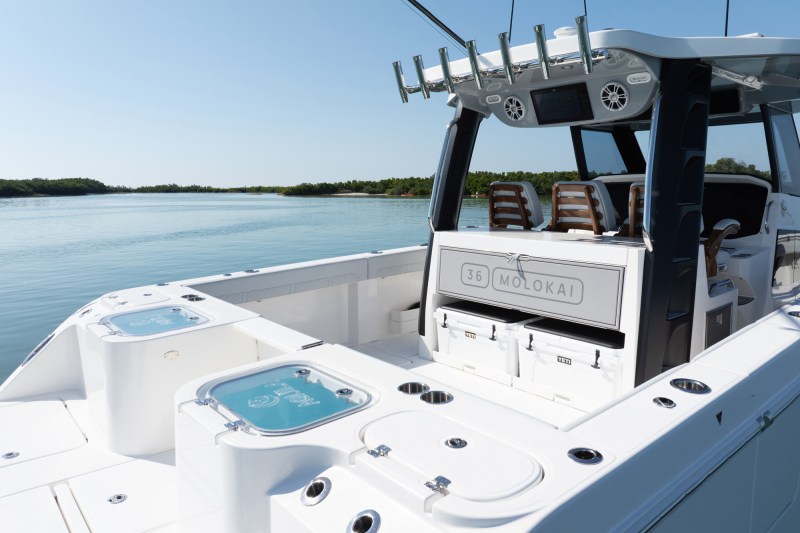
That offshore capability is matched by a cockpit designed by people who understand how serious anglers use their boats. Live-bait management is particularly well executed. Two 53-gallon transom livewells are complemented by a third 58-gallon in-deck well. This allows crews to separate bait species or use the larger center tank to replenish the transom wells throughout the day. The system is fed by Hooker pumps via a custom sea chest featuring both high- and low-speed pickups, while variable-speed controls at the helm allow precise adjustment of flow rates depending on sea conditions or bait sensitivity. For those targeting larger pelagics, optional tuna tubes can be installed opposite the livewells.
Another smart touch is an aft-facing, 18-inch Raymarine multifunction display integrated into the hardtop. It allows the crew to monitor the sonar while working bait schools and to keep tabs on structure when bottom fishing.
At the center of the action is an aft-facing bait-prep station that functions as the cockpit’s command post. A cutting board, sink, grill and tackle storage are neatly arranged, while a pair of Yeti coolers on sliding mounts can be tucked away for when you need the deck space. When extended into the cockpit, they create extra seating. Foldaway transom seating provides more flexibility, completely disappearing when fishing and flipping open when it’s time to run to another spot over the horizon.
Rod storage is abundant. Our test vessel had seven holders integrated into the rocket launcher along the trailing edge of the carbon-fiber hardtop and 32 additional rod holders spread throughout the boat. Massive insulated in-deck fish boxes extend well forward into the sponsons, providing enough length for even the biggest wahoo. It’s one of those benefits unique to a catamaran design: usable volume hidden within the beam and hull structure.
The same practical thinking continues throughout. A starboard-side dive door and swim ladder at the transom make water access simple. At the bow, a large sunpad offers lounge space for guests when cruising, with stowage beneath that can serve as a dry locker or another fishbox when needed. The bow houses the windlass and dedicated dock-line lockers, while the foredeck can be pre-wired for trolling motors—an increasingly popular option among anglers looking for more precision when targeting nearshore species.
At the helm, the catamaran’s broad beam pays dividends. Triple helm seating is a luxury on a 36-footer, allowing the captain and crew to rideside by side in the protection of the large windshield. Our test boat was equipped with twin 22-inch Raymarine displays, though buyers can configure three 19-inch screens if preferred. A B175 transducer provides high/wide Chirp sonar, 3D imaging and structure-scanning capability. A Mercury joystick control adds another layer of confidence when docking.
CZone digital switching controls much of the boat’s systems; it’s a sophisticated feature uncommon on boats in this size class. Aquila also provides physical switches overhead, a practical redundancy that can make operation easier when touchscreen precision becomes difficult in rough seas.
Owners can also opt for a lithium-ion battery system to power the boat’s systems, including air conditioning and pumps, for up to eight hours. With this system, owners can plan for a quiet day on the hook or long bottom-fishing sessions.
Belowdecks, accessed through a pantograph door in the console, the 36 Molokai reveals another layer of Aquila’s big-boat DNA. The space is compact, but remarkably usable for a serious fishing platform. With 56 inches of headroom, climate control, a wet head and easy access to electrical systems, it functions as a practical retreat from weather and as dry stowage.
That same thoughtful engineering is present in the details. Large bilge hatches provide excellent access to pumps and service points. Nylock locking nuts on handles and hardware help prevent loosening from vibration. They are small touches, but they speak volumes about design priorities. Four electric-reel outlets—two aft and two forward—support a range of fishing styles, while freshwater and raw-water washdowns are positioned where they should be. Taken individually, many of these details might seem incremental. Taken together, they create a boat that feels complete.
Aquila’s Molokai series already carries tournament credibility. In the 2025 Big Dog Fat Cat KDW Tournament, a team representing MarineMax Jupiter, MarineMax Pompano and Aquila Power Catamarans claimed top honors aboard the Aquila 47 Molokai against a field of more than 200 boats. The 36 shares that competitive DNA.
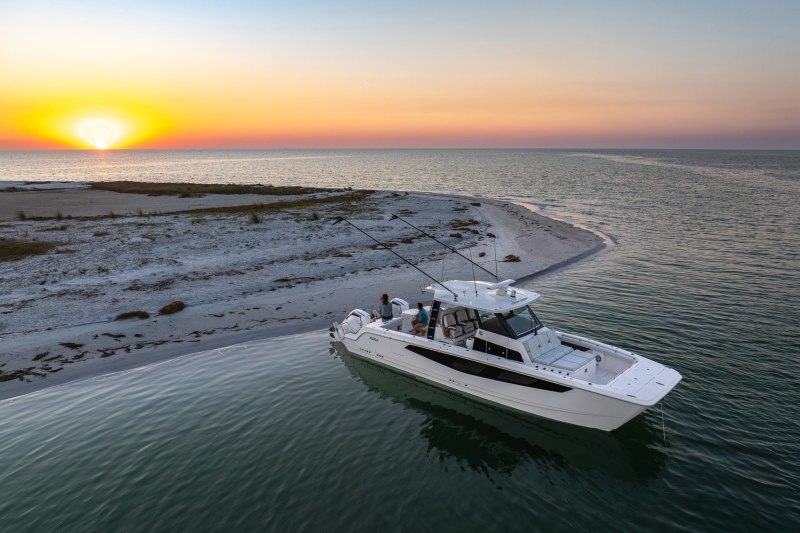
The 36 balances a fish-first mentality with broad versatility. It can chase pelagics offshore, drift a reef edge, serve as a capable dive platform or host the family for a sunset cruise. This Molokai feels bigger, smarter and more polished than its dimensions suggest. For anglers looking to fish far and get there fast without giving up comfort or confidence, this one is a compelling option.
Specifications
- Length Overall: 38’2”
- Maximum Beam: 11’9”
- Fuel Capacity: 508 gal.
- Freshwater Capacity: 21 gal.
- Range at 43 knots: 370 nautical miles
Mercury Muscle
Standard power for the 36 Molokai is twin Mercury 300-hp outboards, but most buyers will step up to Mercury’s 400 or 425 hp V10 engines. Mercury is the exclusive outboard power option for Aquila Power Catamarans, and the builder works closely with the engine manufacturer to ensure a good relationship between hull design and available power options.
Take the next step: aquilaboats.com