Vicem107
To get to be the first to sail on a brand new boat is a privilege. To enjoy her maiden voyage, an even greater joy.
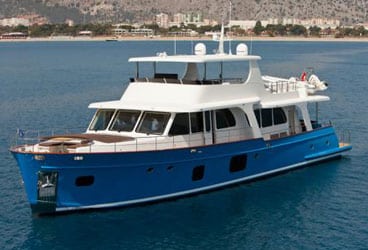
Our ride was the Vicem 107, the largest in this company’s classic line. Her name, voted upon by Vicem‘s workers, is Moni, which in the Laz dialect of Turkey refers to the evil eye, a ubiquitous good-luck emblem in this nation. This shakedown trip, from Marmaris to Bodrum, was designed to wring out Moni as we delivered her to her home port for the season.
The roughly 100-mile journey to Bodrum at 10 knots took about 10 hours to complete. We traveled within the Turkish cell-phone coverage area and ducked in toward the coast to pass north of the Greek island of Simi. Sea conditions were smooth, with just a long swell left over from some earlier storms, and Moni handled it well — rising, falling and gently pitching in seakindly fashion. The coast’s rocky and steep landscape, scattered with trees and sparse green vegetation, looks barren from the sea. It gives the impression of having been bleached by the hot Mediterranean sun. Looking out to sea from here it’s easy to imagine another age, even as far back as the time of Odysseus. Then as now, the sea here would have been full of vessels sailing to and from what are now the Greek islands and the nearby mainland of Turkey.
Close to Simi the scenery changes. Here small houses are built up the hillside in clusters. In case that implies dense habitation, let me hasten to add that most of the island is uninhabited and as sparely vegetated as it must have been during the Bronze Age. Sailing past Simi and hugging the mainland we notice patches of brown, bare soil dotting the bleached hills, but the steepness of the terrain quickly dispels any notion of fertility. It is dramatic and undeniably appealing, with a wild feeling long missing from our mostly overbuilt world. Yet all too soon the signs of civilization return: more and more houses and a gently undulating line that indicates the location of a road along the coastline.
We stopped once, anchoring in an idyllic bay close by Marmaris, called Kumlubuk and home to a yacht club of the same name. Ashore, the countryside is a riot of early summer color, and the aromas of wild herbs were as much a joy to the nose as the vista was to the eye — fresh sage, wild oregano and pine are just a few examples of what we found. Dinner was served on the terrace of Hollandalı Ahmet, a delightful restaurant on the water’s edge.
Back aboard, I had a good look at Moni and marveled at the workmanship. She’s a composite vessel, built from cold-molded mahogany in one of the company’s three manufacturing plants in the free-trade zone of Antalya, in southwestern Turkey. She’s a modern-day testament to the age-old tradition of wooden boatbuilding, where craftsmanship is king. While many may argue that using vacuum-bagged cold-molded wood is nothing more than a standard composite construction technique, others will swear that it is at the pinnacle of wooden boatbuilding methods. It is only when talk turns to hull weight that the traditionalists begin to lose ground. Although cold-molded hulls weigh the same as, or less than, conventional GRP examples, the most sophisticated carbon fiber laminates and many resin-infused hulls are lighter. Our host, Sebahattin Hafizoglu, is chairman of Vicem, and his yard on the Bosporus was among the first to embrace blending traditional skills found in the construction of the Turkish gulet with emerging cold-molded wood-and-epoxy techniques. Pestered by local resorts and businessmen clamoring for anything he could build, he started Vicem. Twenty years later, the wider world, and in particular the North American market, have come to recognize Vicem’s great-looking designs and superb craftsmanship.
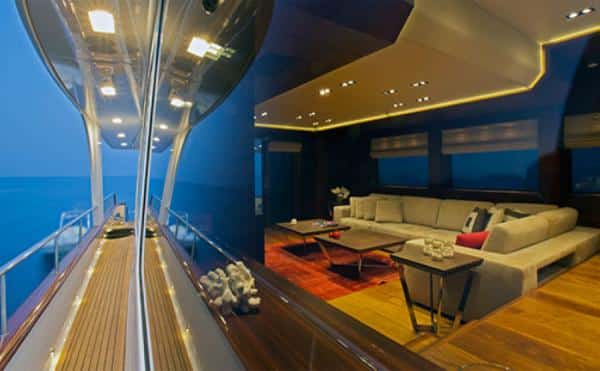
That artistry is evident in the 107’s main salon, which is traditional in its style, yet the light-handed touch of the designers has given it a contemporary twist. Wide open on two levels, a sole of sapele planks runs fore and aft with the wide boards pleasingly offset. Mahogany bulkheads are darker than the deck. Large side windows and an overhead covered in a light textile ensures that the space is not dark or cavelike. An L-shape sofa to port is finished in a pale mouse-colored suede and separates to allow flexible seating arrangements for five guests. Two low coffee tables on red-pattern rugs and two small matching side tables complete the picture. One step takes you up to the dining area, where a walnut table comfortably seats eight and can be expanded to seat 10. The bulkhead between the dining area and galley cunningly conceals a wine chiller and racks for stowing bottles. The multimedia entertainment locker houses an Apple TV, which may discourage conversation at dinner, and a Sonos sound system.
Lots of natural light streaming onto a central stainless-steel countertop floods the portside galley, where Gaggenau appliances await the chef. Opposite the galley is a day-head set beside a glass-wall staircase leading to the lower deck. Here we find the master suite aft, the VIP forward to starboard and a pleasing double to port. On the starboard side is a pair of double-bunk cabins, which is ideal for the kids. Cabins are arranged along a light-color companionway with plenty of headroom.
The full-beam amidships master suite features massive side windows, making this an attractive, well-lit space. To starboard is a leather-top vanity unit; to port, a small sofa covered in orange material has drawers underneath. Leather is used to great effect in this stateroom — soft, padded, brown-leather panels surround the king-size bed and make it seem even bigger. A voluminous bathroom features a large shower with a rain showerhead, under-sole heating and a double wash basin. This space is beautifully finished with light-color Turkish marble.
This yacht’s portside double cabin has spacious cupboards and a very large window behind the bed. The well-appointed head forward features a large shower and glass cupboards over the sink, giving it loads of stowage. The twin cabins opposite share a head. One cabin has twin bunks lying fore and aft; the second has bunks across the beam with the upper a Pullman, so this cabin may be used as a single. This is a very sensible arrangement, since the boat will earn her keep as a charter yacht.
Walk forward to starboard and up two steps to find the VIP suite. A queen berth faces forward with a head to port. Carpets here, as in every stateroom, are of an off-white wool and give a pleasant feel when walking barefoot. There is also an iPod dock and interior phone in each cabin, which can be connected to shore-based systems when dockside.
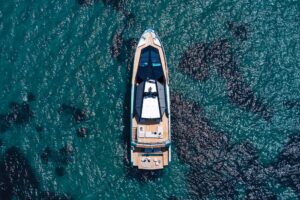
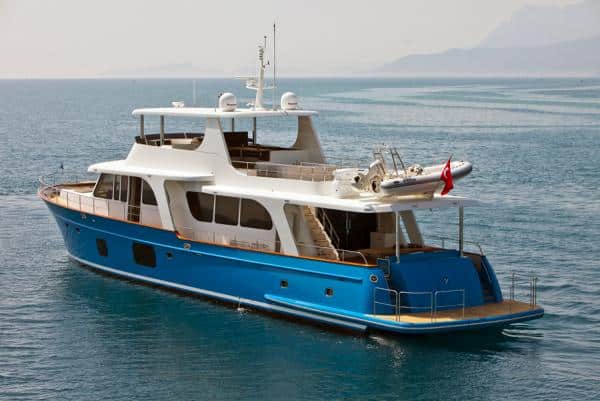
Externally the yacht is well-designed for cruising in warm climates. A substantial hardtop provides plenty of shade and covers half of the large sun deck. While hugely practical, it does little to add to the otherwise pretty line of the 107’s exterior styling. Had the stanchions been made of ellipsoid-shape brushed stainless steel instead of polished box-style, we think the overall style of the yacht’s exterior would have been enhanced. That said, the sun deck is laid out in a practical fashion that maximizes family fun and enjoyment. Two Jet Skis and a substantial tender stowed aft can be removed, along with all the fixtures that secure them, and this further enlarges the sunbathing area or creates a dance floor. A wet bar, a barbecue grill and an enormous teak dining table, which converts to two small coffee tables, turns the deck into an alfresco playpen. Forward and to port there is a lounging area, while to starboard the flying-bridge helm duplicates much of the control and command equipment that is found in the 107’s wheelhouse.
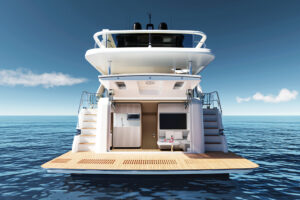
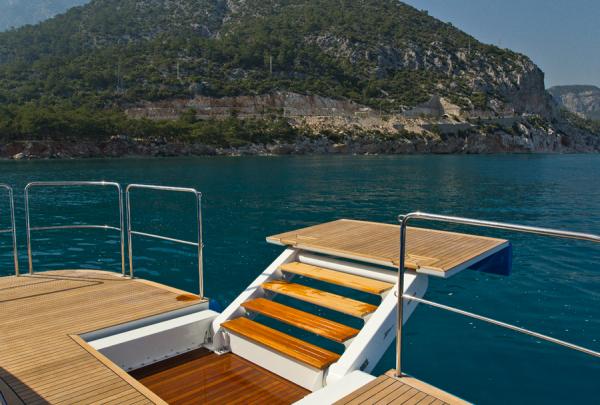
The cockpit on the main deck is a delightfully sociable area with a large unvarnished teak table surrounded on three sides by upholstered benches, with four orange-mesh and stainless-steel chairs servicing the forward side. Wide steps lead up to the sun deck and down to the swim platform. Here a clever Opacmare Transformer device allows easy access to a variety of dock levels and can, when at anchor, convert into the most luxurious of swim ladders or a diving platform.
Wide walkways to either side lead to the foredeck and its inviting sun pads, which have enough space for four. A small semicircular seating area has a teak table, ideal for an intimate dinner or perhaps an early breakfast. Removable stainless-steel stanchions support hammocks for those who like to sway while sunbathing.
The pilothouse is well equipped and ergonomically laid out. Dark-brown leather seating surrounds a small table with a leather inset located to port. Her center helm area is finished with a pleasing mix of dark-brown and cream leather on either side. Two Opacmare helm chairs finished in light-brown leather are fully adjustable using electric controls in the armrests. To starboard is the wheelhouse door and a dark-brown leather-top chart table. The yacht’s radio equipment desk and pod stool with stowage are on the after bulkhead.
Small, well-equipped crew quarters lie aft behind the engine room and are accessed from a door to port. While this is well-suited to the yacht’s locally based crew, western crews might find it somewhat cramped. A little galley/mess leads to the engine room, a captain’s double berth cabin, a crew cabin with bunks for three and a stewardesses cabin, which also houses a washer and dryer under the single raised bunk.
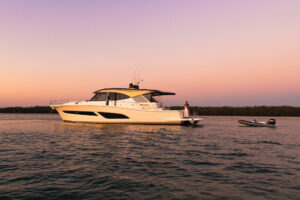
On a gloriously sunny afternoon, we arrived in Bodrum and moored at the Kempinski Hotel, where Moni will be based for charters along the Turkish coast and the nearby Greek Islands. We had avoided a single issue on her shakedown trip, suggesting that this lovely yacht is well-named indeed.
Moni is available through Fraser Yachts. She takes nine guests at a lowest weekly rate of $62,850. Contact Antoine Larricq in Monaco at +377 93 100 462; fraseryachts.com
View a photo gallery of the Vicem 107 here.
Click here to see the performance data for the Vicem 107.