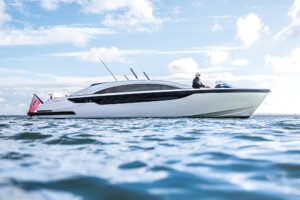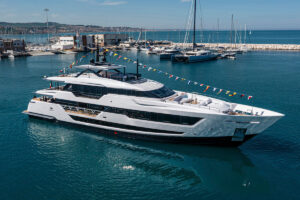
Choey Lee 76 Alpha Main
After testing and evaluating boats for more than a decade, you acquire a calloused layer of cynicism. For example, you’re inevitably presented with the Mark XXV version of a model that a builder promotes as “completely new,” yet it really only showcases the latest in counter surface technology and soft goods — not much else sets it apart from the previous 24 versions. Or even more suspect is the boat marketed as a “new build” constructed with 25-year-old tooling that’s been collecting dust in the corner of a defunct factory.
My hackles really stand up when I’m told by a builder, “Wait until you see what we have coming — it’s totally different and fresh. But I can’t say anything now. We’d both be in danger. Shh.” That general context sets off all types of alarms and caution signs. So, such was my initial reaction when Cheoy Lee began to drop hints of its new Alpha 76 Express — the builder’s first model in its Alpha Series.
The more I tried to guess what this venerable boatbuilder was working on, the more confused I became. The company has set trends over the past several decades with eye-popping builds from Tom Fexas, who created early “Euro” design motoryachts long before some public relations whiz — most likely a European — coined the phrase. During the same period, Cheoy Lee graced the waterways with the traditional Hargrave-designed 92 and 103. Considering this breadth of design, trying to guess where they were going next was not easy. Drum roll, please.
Three years ago, Cheoy Lee identified an opportunity in the highly competitive large express market. B.Y. Lo, vice president and a co-owner of Cheoy Lee, is a savvy businessman who runs the company with the perfect balance of risk and deliberate, well thought out action. Lo has no notion of dominating the express market. He simply recognizes that there is room for a different take on an express yacht — one that capitalizes on his company’s strengths and centuries of experience.
In order to ensure the company’s mission was accomplished, the builder called on yacht designer Michael Peters to design the hull and style the exterior, and Luiz de Basto to design the interior. The express cruiser market is a tough segment of the industry to crack, especially for a company that earned its reputation building commercial ships and long-range yachts for the cruising crowd. Yet by creating a pedigree-fueled team, Cheoy Lee has created quite the stir since the model’s October debut.
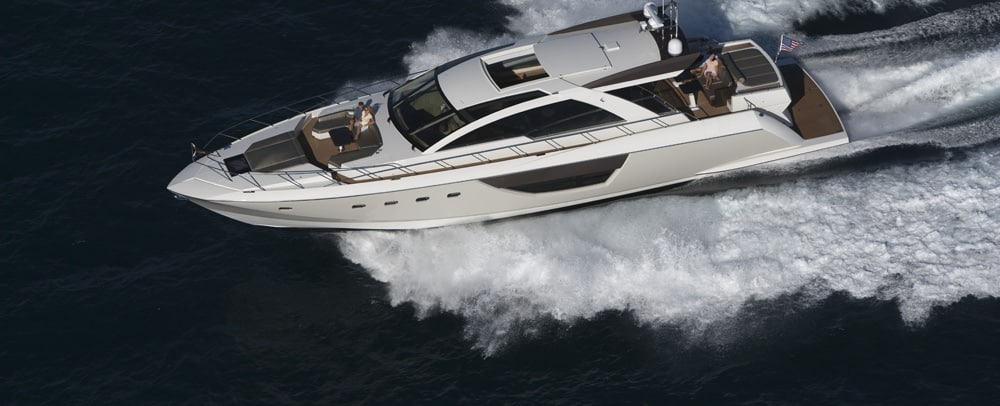
One aspect of the Alpha 76 I like is the builder’s choice of straight shafts coupled to V-drives. The team explored pod-drive applications, yet was hesitant to get into triple or quadruple pods. When long-anticipated higher horsepower pod models did not materialize, Cheoy Lee and Peters went with twin 1,900-horsepower Caterpillar C32 ACERT diesels joined to ZF 350V gear boxes. Although the builder continues to tweak the props, our test ride proved that this power package combined with Peters’ hull is a damn fine combination. At 1800 rpm, running in three- to five-footers in a short fetch, we effortlessly maintained an average cruising speed of 27 knots. In these snotty conditions, everyone on board was comfortable, standing, carrying on a conversation and enjoying the ride.
An even sweeter spot is 20 knots at 1500 rpm, burning a total of 80 gallons an hour. I personally spend a lot of time offshore and I rarely find the conditions that let me consistently take a boat to more than 30 knots, or higher cruising speeds. Although, when we put the throttles down to a top speed of 38 knots on the 76, we never took a drop of spray over the windshield.
Peters drew a moderate V-shape hull, with convex forward sections, transitioning to a 17.5-degree deadrise aft. If an owner is intent on hitting that 40-knot top speed mark for bragging rights, Cheoy Lee is confident it can achieve the speed with additional engineering.
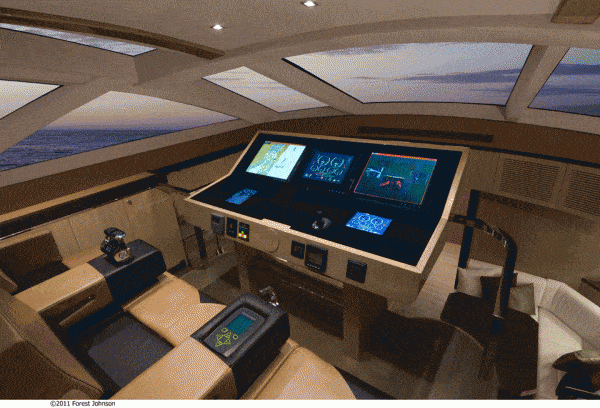
The high-performance inspired helm seats create a snug perch for piloting this thoroughbred. Our test boat featured a joystick steering option and a removable conventional steering wheel. The concept is that the helmsman can sit back comfortably in the chair and make easy adjustments without moving. I get it. Yet, for me, a good old reliable wheel and an autopilot remote will do just fine.
The helm itself is a superbly designed piece of furniture by De Basto that could be on display at New York’s Museum of Modern Art. There was simply no bad angle. The line of sight from the helm was good and it was easy to see traffic in all corners.
During our sea trial, noise emanating from the interior workings was minimal. Even so, the builder wants to further reduce noise. “We’ll round the edge of the forward inside chines slightly and put in some sound deadening up forward as well,” said Marty Isenberg, director of marketing and sales for Cheoy Lee. “That will help quiet her down even more.” The 76 feels solid and tough underneath. Like Cheoy Lee’s motoryachts, the 76 is built using monocoque construction that bonds all structural components directly to the hull.
The tanks are fiberglass and integral, another practice Cheoy Lee has executed all their designs for years. “The integral tanks are down low, increasing balance and lowering the center of gravity. The tank baffles become structural transverse web frames, while the tanks create a double bottom,” explained Isenberg.
I would like to see a tad more fuel capacity to give her a little better range. Granted, the 1,060 gallons of fuel capacity is similar to her competition’s, yet the 76’s accommodations, interior volume and equipment create a model that differs from the typical cocktail sled. She can cruise. Loading up with gear and provisions for a month in the Exumas, or maybe an adventure through Alaska’s Inside Passage, would be a no-brainer on the 76 — and it would be a hell of a fun ride that you’d want the tankage to accommodate.
De Basto put Peters’ full-body beam to good advantage. Sitting on the settee in the master stateroom, I could have been on one of Cheoy Lee’s larger motoryachts. The full-beam space is impressive. And I almost wept with happiness when I saw a hull side window that brings in the light but doesn’t detract from the boat’s clean exterior lines.
Cheoy Lee uses CNC machines almost exclusively on the interior, resulting in tight joints and precision fits. Furthermore, the intricate design details laid out by De Basto can be executed to perfection. Cored cabinetry, a practice perfected by the builder on its larger motoryachts, reduces weight for increased performance and economy. The most impressive example of this is in the master head. Rich marble created from one slab feels as if you’re standing on a piece inches thick — on the 76, it can be measured in millimeters. The marble surfaces are created with a CNC band saw and then epoxy laminated to a honeycomb core. Slick.
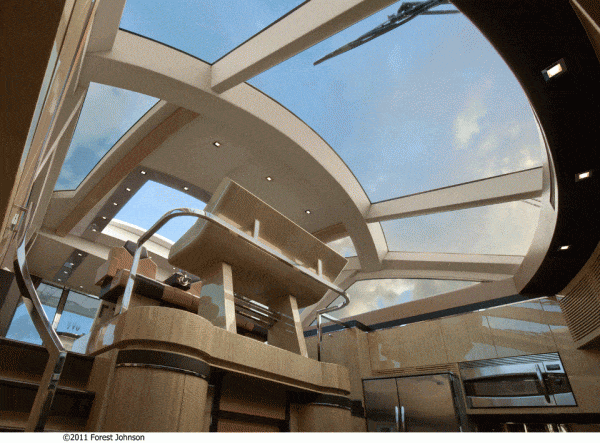
The galley and dinette are forward of the master suite and benefit from the atrium light created overhead by the three-panel windshield. Prepping breakfast in the large U-shape galley while the sun streams in from above before heading out for an early morning snorkel will be a joy. Equipment includes a full array of GE appliances. The settee opposite has a direct line of sight to the helm area.
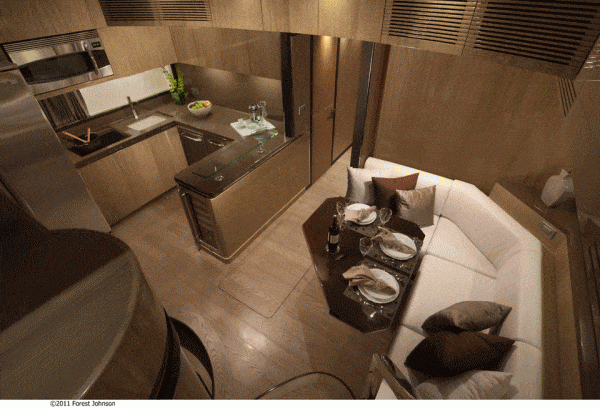
Forward of the galley, there are two additional staterooms and heads. Crew accommodations are forward of the engine room.
The salon follows a popular trend of creating seamless transitions between the outdoor and indoor accommodations. The only item that separates the two areas on the 76 is a well-placed bar unit that is perfectly situated for large-scale entertaining. A day-head here is also convenient. A settee and high-low table accommodate alfresco diners on the afterdeck. A Jacuzzi tub abaft the settee can be filled with fresh or salt water. The large swim platform accommodates a tender or PWC.
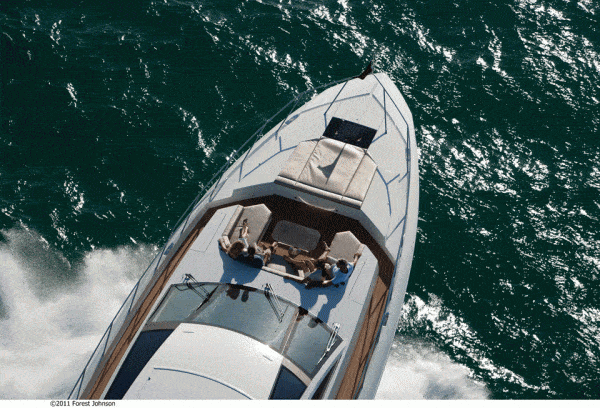
Cheoy Lee chose a synthetic PVC decking that looks and feels like teak, but with none of teak’s maintenance issues. The walkways are wide with high bulwarks and stainless-steel work that will be the envy of any builder. A cozy forward U-shape settee with table is placed on the bow.
Future plans call for one launch per year in the Alpha Series for the next several years. The next model is a 76 flybridge slotted to launch later this year, followed by 86-foot express and bridge models.
If you like hull number one of the 76, you’ll need to wait for the next slot. Cheoy Lee is holding onto it for the foreseeable future in order to thoroughly test the boat and evaluate systems. Besides ensuring everything works as advertised, the company wants to be certain the Alpha stays true to its demanding standards. “Every boat we build needs to be better,” said Lo. Considering the execution of the Alpha 76, they have indeed raised their own bar.
View a complete photo gallery.
Read “A Conversation with Luiz de Basto.”
Test Conditions: Speeds were measured by GPS off Fort Lauderdale, Florida, in three- to four-foot seas and 15 to 20 knots of wind, with a ¾ load of fuel, ½ water and eight people on board. Fuel consumption was calculated by the engine-monitoring system.
RPM Knots GPH
700 8.0 10.8
900 10.9 23.0
1200 13.6 47.6
1500 20.0 80.8
1800 27.0 132.0
2100 32.1 161.4
2260 38.0 200.0
LOA: 76’6″
LWL: 59’5″
BEAM: 19’8″
DRAFT: 5’5″
DISPL.: 107,000 lb.
FUEL: 1,060 gal.
WATER: 264 gal.
ENGINE OPTIONS: 2 x
1,550 hp MAN V-12 diesels
ENGINES TESTED: 2 x
1,900 hp Caterpillar C32 ACERT diesels
PRICE AS TESTED: $4,750,000
Cheoy Lee North America, 954-527-0999; www.cheoyleena.com