Sportfishing Main
“Many men go fishing their entire lives without knowing it is not fish they are after.” This quote by Henry David Thoreau comes to mind when I see sport-fishing boats soaring to more than 100 feet in length. How far we’ve come from the early days of the sport, when boats were built simply to chase billfish and tuna. These early designs crafted by Rybovich, Whiticar and Merritt challenge the popular notion that bigger is always better.
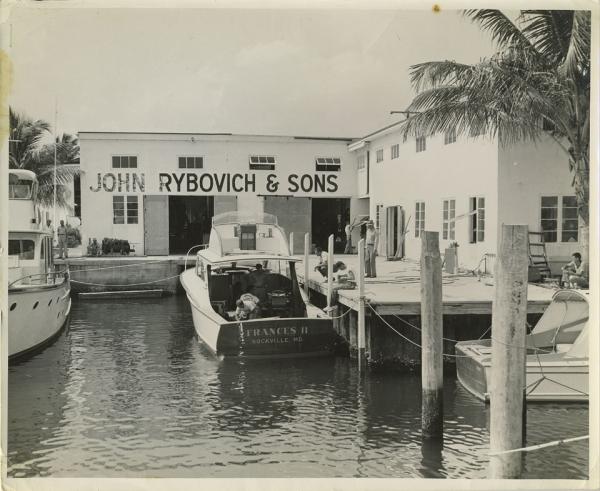
“When folks go fishing these days, they don’t want to leave anything behind … the house … the office … the works,” said Mike Rybovich, boatbuilder and son of Emil Rybovich, one of three brothers who were the first family of tournament fish-boat building. There is little argument among those who are fishy that the modern tournament fish boat was invented in Palm Beach, Florida, at the Rybovich & Sons boatyard.
The brothers Rybovich — John, Tommy and Emil — had grown up in their father Pops’ service yard. “Uncle John loved to fish. … A 26-foot boat the yard took in trade for an unpaid bill served as his test bed,” Mike Rybovich said. Most credit John Rybovich with the invention of the modern fighting chair, aluminum outriggers and the tuna door. “Uncle Tommy was a genius in boat design and was always trying to figure out how to make a hull more efficient.” Emil took Tommy’s and John’s ideas and made them work. “Dad was a born troubleshooter and problem solver,” Rybovich explained.
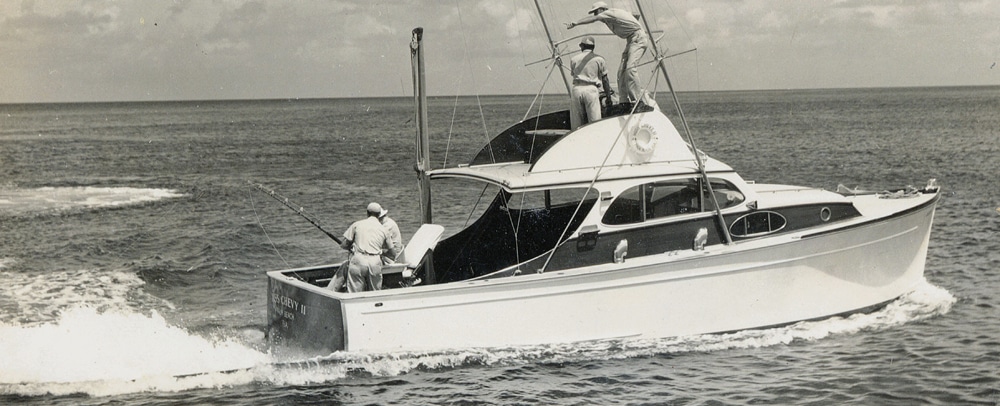
By the late 1930s, the big game-fishing adventures of Zane Grey and innovations in tackle had inspired anglers to modify the cruisers of the day for deep-sea fishing. This kept the Rybovich yard busy before the war, and it was this experience and a good customer that led to its first build in 1947. The 34-foot_ Miss Chevy II_ was designed to fish the Cat Cay Tuna Tournament — she would be a teak and mahogany jewel box. A veteran of the tournament, John Rybovich explained to his brothers what was needed. Tommy came up with the drawings and Emil chose the power.
The Rybovich brothers built 79 boats in the next 28 years — a team effort — sort of. “The notion that we were one big, happy boatbuilding family is not quite accurate,” Rybovich said with a laugh. “My dad and uncles loved each other dearly, but like all siblings there was competition — each wanted to be better than the other.” The most frequent conflict was between Tommy, the visionary designer, and Emil, the practical engineer. “Dad idolized Uncle Tommy but it bugged him that Tommy would never run the boats — Dad did all the sea trials,” Rybovich said. “No boat is perfect, and if Dad suggested a problem or an improvement, it would cause a major stink.”
Ultimately the brothers worked together and the boats evolved — each a bit better than the one before. Today Mike Rybovich builds outstanding fishing boats — 20 to date, from 24 to 78 feet. All have been built of cold-molded wood; however, Rybovich is considering other materials and is working on even larger designs. “For me it’s all about a good result — a good boat.”
About the time Pops Rybovich was settling in Palm Beach, Addison Whiticar arrived in Florida to fish commercially in the waters off Stuart — just 40 miles north. As tourists flocked to the area after World War II, wealthy anglers sought the services of Whiticar and his sons Curt, Jack and Johnson. Such were the humble beginnings of the Whiticar charter fishing fleet. Unlike Rybovich, Curt Whiticar created his first 11 boats for his personal use and the family charter business, said John Whiticar, Curt’s son. John Whiticar now runs the yard with his cousin Jim Dragseth. Jim’s father, John Dragseth, helped Curt build the yard and the fleet. “By the early 1950s,” Whiticar said, “our family’s charter customers began commissioning their own boats. Most averaged about 38 feet in length and were very basic compared with what we build today.” These early Whiticars were plank-on-frame construction. Most were powered with gas engines and ran about 18 knots. Whiticar’s most recent builds are state-of-the-art tournament designs with cold-molded hulls and cored fiberglass superstructures. The yard’s last two 76-footers cruised at about 30 knots.
Brothers Buddy and Allen Merritt were veterans of the Cat Cay tournaments as well. They began building boats in 1955 at their family’s service yard 20 miles south of Rybovich’s in Pompano Beach. “Uncle Buddy built the boats and my dad (Allen) managed the business — he still comes to work today at age 89,” said Roy Merritt, who has managed the yard since the mid-1970s. “Uncle Buddy was a pioneer in tuna fishing,” Merritt said. “Back then some skippers put seats atop the gin pole so they could see. … Uncle Buddy put a mast on the boat with a control station — basically two ropes led through blocks to the bridge wheel. He looked like he was milking a cow up there,” remembered Allen Merritt.
“In 1955, Uncle Buddy finished a 34-footer my granddad had started,” Merritt said. “She was designed and lofted by the Norseman yard in Miami.” Buddy Merritt designed her cockpit and her graceful profile. “Uncle Buddy knew how a fishing boat should be.” She was built for a charter guest, and Merritt remembered she cost about $17,000. The 34 grew to 35 and then became the iconic 37 Merritt. Her size was tailored to the fishery. “The whole idea of tuna fishing with big boats doesn’t work; the flat wake of the 37 was perfect. It was the boat to have, and we were fortunate to have the best crews fishing them at the time.” In all, just 12 37s were built, and all but two are still in service. The boats that followed the 37 were larger and just as successful. “In the 1970s I asked my granddad if I could build a boat using the jig we had for a 42 — it seemed a lot better than painting bottoms,” Merritt said with a laugh. The 42 became the 43 — 13 were built. Three 53s, a 54 and a 55 followed — all classics.
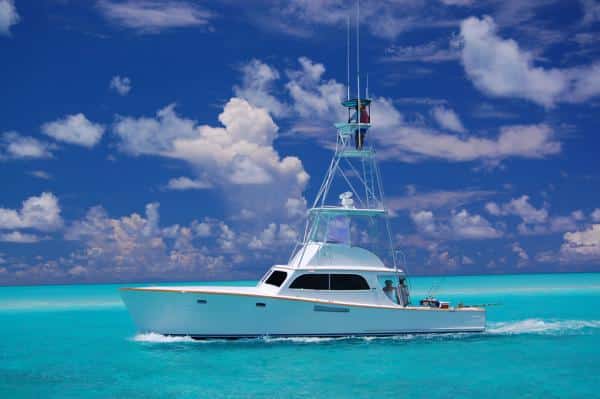
Some captains say Roy Merritt can be opinionated when it comes to his boats, but that’s a good thing. “It’s true we build boats a certain way. … We feel it’s the right way,” Merritt said. “If someone thinks differently I’ll listen, but they’re going to have to explain why different is better.” Merritt has advice for those thinking of building a boat. “An old captain once told me that, if you figure a certain length boat is perfect, add 10 percent and it’s a whole lot better — I think he was right.” Today Merritt’s 72-, 78- and 86-footers are molded fiberglass and Kevlar with closed-cell foam coring. If the right customer asks, Merritt will consider building in wood, and he is currently finishing a cold-molded 66-footer. As for Merritt’s favorite boat, he won’t say, but he owns a 42 he helped build 44 years ago.
In my opinion, the fit, finish and sophistication of the modern tournament fish boat sets the bar for all yachts no matter the size or purpose. Does it make sense? “My dad would turn in his grave if he knew how much time we spend making engine rooms pretty — he’d think we were wasting the customer’s money,” Rybovich said. Merritt agrees but added, “Our customers are allowing us to be our best. … We are very fortunate.” For Rybovich, Whiticar and Merritt it’s always been about satisfying those fishing for perfection.