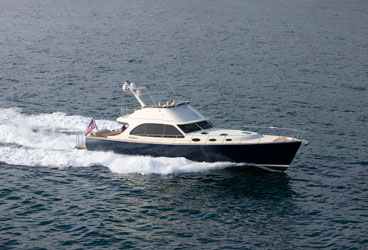
Palm Beach 65
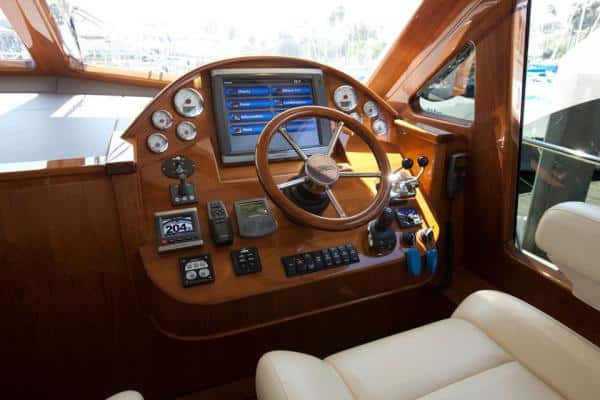
The logo etched into the hub of the Palm Beach 65’s steering wheel reminded me of the badge on the nose of a Bentley Continental GT, but inverted so the wings appear to be locked in a power dive, instead of playfully soaring on a thermal.
Bentley Motors and Palm Beach Yachts: These two marques, one nearly as old as dirt and the other a fledgling founded in 1995, share a similar philosophy — provide the customer with a product that’s as close to perfection as humanly possible. “Ah,” you say to yourself, “the road to perfection is always under construction, full of detours, ‘a worrisome thing [that’ll] leave you to sing the blues … ’” to quote Johnny Mercer’s lyrics from “Blues in the Night.” In spite of the pitfalls, the team at Palm Beach Yachts may have succeeded.
You don’t have to be Hercule Poirot to find evidence of the builder’s efforts. Simply stroke the glossy woodwork with your fingertips or sight along the surface of the dinette table. You won’t see or feel any flaws in the finish. Powerful magnifying glass in hand, examine each joint for the tiniest gap or unevenness between two surfaces. Zero. In keeping with Palm Beach’s take on traditional New England styling, Herreshoff cleats of stainless steel sprout from the teak decks in all the right places. Custom stainless-steel chocks guide the mooring lines to their destinations. Gently run the tip of your finger over the welded joints of the safety rail. If you detect any evidence of the customary weld bead, you’ll get a prize — yet to be determined.
View the complete photo gallery here
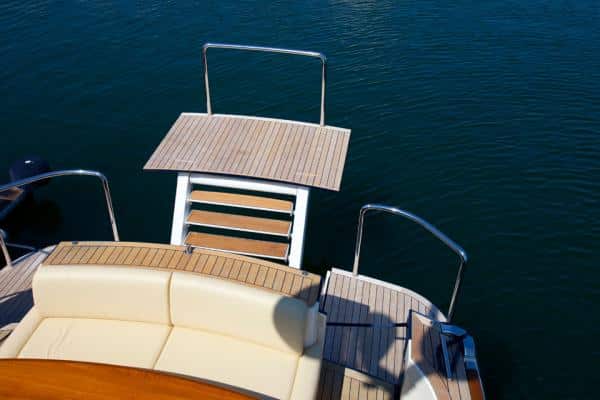
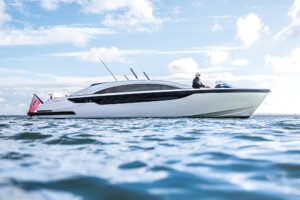
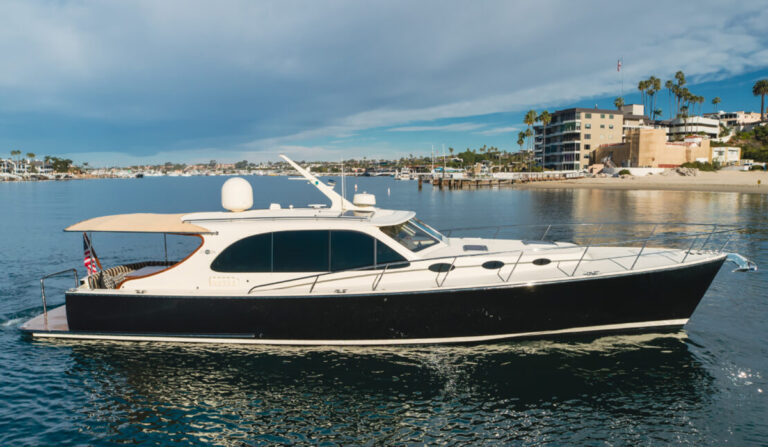
I met Guilty, a flybridge model of the 65 with a unique general arrangement plan, floating serenely starboard, side-to, on a face dock in Santa Barbara, California. She dwarfed all of her slip mates, in spite of her low profile — that is, low for a 65-footer. As I walked toward the yacht, her dark-blue topsides and white trunk cabin, clearly visible between the line of boats on each side of my approach, began to dominate my view of the horizon. Flare in the bow sections of the PB 65 shaded that part of the hull from the midday sun, deepening the blue finish. When I turned left and headed for the stern, the tumblehome in the after sections captured the sun’s rays and reflected the glow of white from the neighboring boats.
This hull is all about shadows and highlights, and a person needs enough distance to catch the whole boat in a single look to appreciate how shapely she is. Mark Richards, owner of Palm Beach Motor Yachts, designed the 65 and her smaller siblings. He made his reputation building high-tech maxis and America’s Cup yachts, and setting records for victories in the Sydney Hobart race. He should be happy with the 65.
A lot of builders get the obvious markers correct — or “correct” enough to pass the normal examination — but the true clues to a company’s obsession with quality hide from the view of all but the most careful shopper. As I stepped through the doorway to the salon, admiring the finish on the bifold door and the surround, the hinges caught my eye. After I retrieved it (my eye), I saw that the crisscross on the head of each Phillips screw perfectly lined up with every other one on every hinge. Same for the hinges on the middle joint of the door, and I found details of this sort everywhere. To wit: The reveals of each door and drawer were very narrow, and when I looked at the bank of them in the galley, I discovered that all of the reveals were visually the same width. The drawers slid fluidly in and out, and the doors opened and closed without the slightest protest.
I looked for flaws within the depths of every stowage locker and cabinet, but didn’t find any, and then Capt. Mitch Marvosh showed me the engine room. It has a teak sole and gelcoat on the exposed fiberglass surfaces. I’ve seen less luxurious living quarters aboard some boats. Access to the inline six-cylinder Volvo diesels is more than good enough to do routine maintenance chores. The wiring and plumbing runs are beyond tidy, and well labeled.
The owner of Guilty never intended to spend a night aboard, but that doesn’t mean she lacks proper accommodations. In the master stateroom all the way forward, a large island of comfort awaits the weary voyager. Honey-tone teak ceilings glow through their glossy finish, as do the book-matched faces of the stowage drawers beneath the berth. Although natural illumination in this cabin comes only from a hatch above, the beige carpet and white overhead seem to enhance all the light that enters. Strategically placed electric lights make the area seem as bright as the outdoors.
Palm Beach offers a variety of standard interior arrangements, some with the galley in the pilothouse salon and others with the galley belowdecks, on the port side abaft the master stateroom, and with a double stateroom for guests opposite. The owners of Guilty elected to replace the double stateroom on the starboard side with a U-shape dinette/lounge. Amidships beneath the helm and a couple of steps down from the galley, another stateroom accommodates two more guests in single berths, placed foot-to-foot athwartships. The only full standing headroom in this cabin is located on the yacht’s centerline between the berths, but no matter; it’s more a playpen for the owners’ children. As arranged, the interior offers the solo yachtsman a nearly ideal home afloat, especially if he likes to entertain.
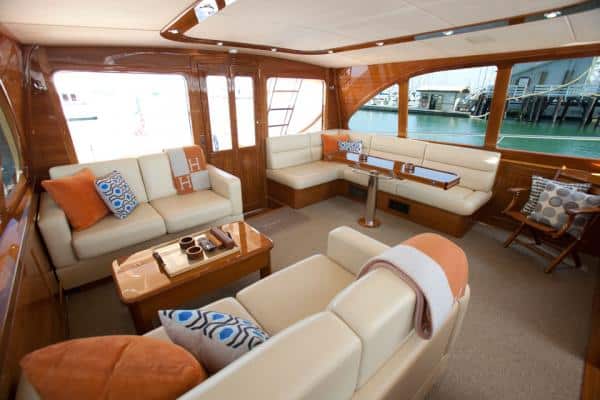
The salon in the pilothouse will play host to most of that entertaining. Cushy love seats, one facing forward, the other aft, look at one another over a varnished teak coffee table on the starboard side — a natural area for conversation. Opposite, an L-shape dinette, with folding table, bids guests to carry on a separate conversation, play a board game or engage their mates across the way. Each window in the salon’s after bulkhead descends into a pocket and, combined with the bifold entry and power-operated side windows forward, ventilate the area well enough to keep the air conditioning quiet on all but the hottest and most humid days.
Enough looking around. The Palm Beach 65 begs to be driven, so Capt. Marvosh fired up the big Volvos, and we joysticked our way out of the marina, taking advantage of the excellent sight lines from the flying bridge to survey the surroundings. We would’ve had nearly as good a view from the pilothouse, because of the massive windows and the boat’s uncluttered exterior.
Although I’ve never driven a Bentley, the Palm Beach 65 behaves the way I imagine driving the Continentl GT would feel like — a deliberate grace coupled with soft tactile sensations through my hands and feet. The yacht is fast enough to satisfy her owner, but more horsepower would make her feel friskier. Speed-conscious owners may want to specify Volvo’s 800 horsepower IPS1050 or 900 horsepower IPS1200 or their D-series equivalents with straight-shafts or jets. Her response to steering input is quick and satisfyingly precise, and she feels nicely connected with the sea, inspiring the helmsman’s confidence. We had to drive through our wake to create waves, and she easily shouldered through those. Her motion in a real seaway ought to be equally friendly.
At the end of the day, I had to ask myself, “What’s not to like about the PB 65?” In order to discover any annoying traits in this boat, I’d have to spend weeks, even months, living with her. My gut says that I wouldn’t find many, so I now look forward to trying the PB 55, which will make her debut in the United States at the fall shows.
LOA: 70’0″
BEAM: 19’2″
DRAFT: 2’11”
DISPL.: 62,700 lb.
FUEL: 1,320 gal.
WATER: 370 gal.
DEADRISE: 14 degrees
engine options: 2 x 800-hp Volvo IPS1050, 2 x 900-hp Volvo IPS1200; straight-shaft also available
engines tested: 2 x 700-hp Volvo IPS900
PRICE: Upon request
Test Conditions: Speed was measured by GPS off Santa Barbara, California, in light chop and less than 10 knots of wind, with full fuel, 125 gallons of water and four adults aboard. Fuel consumption was calculated by the electronic engine-monitoring system. Sound levels were measured on the flying bridge.
RPM Knots GPH dB(A)
600 6.3 3.0 64
900 9.0 5.75 67
1200 11.85 13.0 68
1500 15.05 24.5 69
1800 19.15 37.0 75
2100 23.90 57.5 84
2250 26.50 69.0 81
Palm Beach Motor Yachts, +61-2-4389-1244; www.pbmotoryachts.com; U.S. representative, Ballast Point Yachts Inc., 619-222-3620; www.ballastpointyachts.com