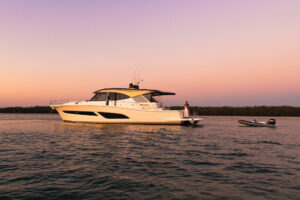
I couldn’t have chosen a better day to cross Lake Michigan from Holland, Michigan, to Chicago aboard the Maritimo 50SC. Brian Dekkinga, Erik Krueger — both brokers at Galati Yacht Sales — and I slipped our lines at noon under a cloud-free sky, in calm winds and a temperature of about 70 degrees Farenheit. Our destination was the site of the Chicago In-Water Boat Show at the new 31st Street Harbor — about 100 miles of quiet, comfortable cruising away.
Click here to view a full photo gallery of the Maritimo 50SC.
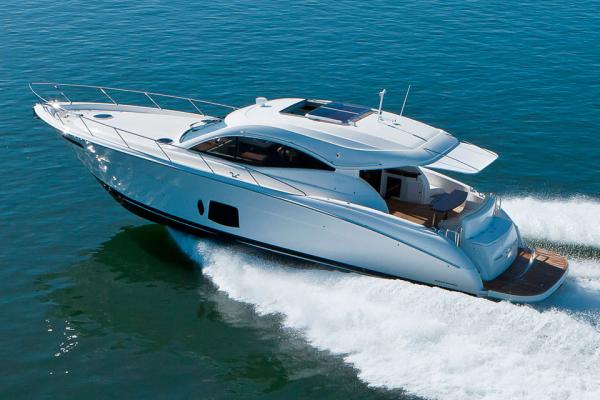
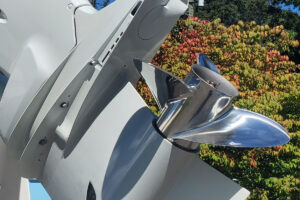
The 50SC’s Volvo Penta IPS power package and careful attention to sound attenuation are responsible for the quiet. I measured just 60 dB(A) at the helm as she idled away from the marina and into Lake Macatawa, the repository for the Macatawa River. Clearing the breakwater and no-wake zone, Dekkinga accelerated the 50SC to a 26-knot cruising speed. She remained quiet, even when we opened the doors to the afterdeck.
Krueger had topped off the fuel and freshwater tanks and loaded our steed with assorted boat-show paraphernalia, stores and personal gear — enough for three nights aboard and four days of the show. The yacht sat a bit low in the water at the dock, so in fairness to her, we decided to forego Yachting‘s customary recording of speed and fuel consumption in favor of Volvo’s sea-trial data of this very same boat, while not so heavily loaded.
Sure enough, after we slowed to idle and then accelerated to record the level of sound, our heavy payload kept the engines 200 rpm shy of the
3,600 rpm maximum recorded and the top speed just below 30 knots, 2 knots short of the top speed recorded by Volvo in Australia.
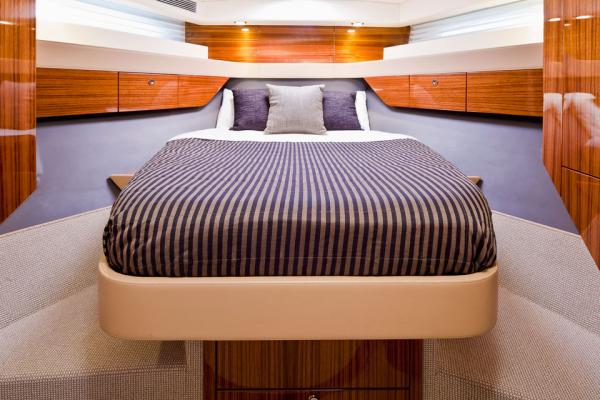
Bill Barry-Cotter, the founder of Maritimo, is also the chief designer. He and his team packed an awful lot of volume into this relatively small package. Placing the engines very near the transom, which is one of the benefits of the Volvo IPS, may have aided the design, but the results exceeded this simple expediency. Regard the master stateroom: Located amidships, it spans the yacht’s full beam and seemed cavernous when I entered. Multiple levels and the queen-size berth at a jaunty angle from the port side contributed to the feeling, but the big portlights in the topsides were my favorite elements. I could have spent hours watching the water rush by. Natural light flooding the stateroom and highlighting the neutral tones of the carpet and upholstery nearly made going topside redundant.
Cozy may be a silly word to describe the ambience of the master, because it’s so large, but I easily pictured myself stretched out on the settee, opposite the berth and a step higher, sipping a single malt and reading The Riddle of the Sands. Up two steps and forward of the bulkhead on the port side is the master head and shower. At this location, the deadrise of the bottom intrudes on floor space but leaves enough for a normally spacious head. The forepeak guest stateroom seemed adequately large, though pinched a little by the hull’s converging forward sections, and it gets light from two portlights in the topsides and two round hatches in the overhead. The single stateroom on the starboard side is perfect for a paid skipper.
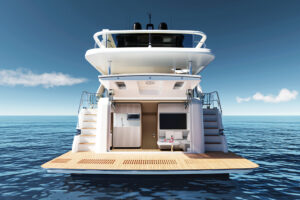
Topside, the open plan from helm to transom makes this 50-footer a fine platform for entertaining. Glass doors open the afterdeck to the salon. On the port side, a single swing door of conventional size lets folks pass to and from the salon. To create a wide-open inside/outside area, simply fold back the bifold door on the starboard side. Hanging out on the afterdeck gets a person a little windblown when the boat’s at planing speeds, but the noise isn’t objectionable. I could easily imagine dinner at the big table aft as the Maritimo creeps along at displacement speed in flat water.
In the salon, the L-shape settee is a perfect spot to lounge with a book, gather for conversation or watch a movie on the flatscreen TV. Pushing a button summons this device from its hiding place in the cabinetry on the starboard side.
Most important to the success of parties aboard is having the galley in the after starboard corner of the salon — in the middle of the fun. The Kenyon gas grill in the cockpit’s entertainment module may add to the menu’s variety. The module also contains a freezer and a sink. The little dishwasher beneath the microwave eases the pain of cleanup.
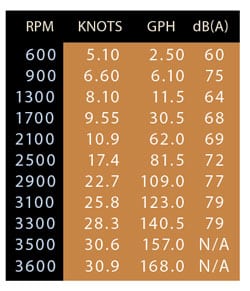
| |TEST CONDITIONS: Sea-trial data was compiled by Volvo. Two-way average speeds were measured by GPS in the waters off Coomera, Queensland, Australia, in winds of 5 to 10 knots, with two people aboard, 100 percent fuel and 40 percent water. Sound levels were measured at the helm. |
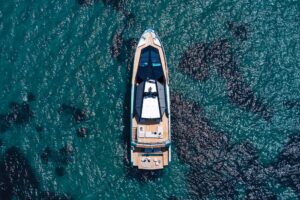
Probably the most astonishing element of the 50SC’s arrangement plan is the dinghy garage. The company’s research showed that yachtsmen have begun to consider this amenity an essential in increasingly smaller yachts. At 50 feet, this Maritimo seems to have pushed the limit, but the execution is no less brilliant. The dinghy garage is above the engine room, accessible via an electrically powered hatch. To launch the tender, simply pull it from the garage onto the articulated swim platform and lower it into the water. As unique as the design is, it makes getting into the engine room a little difficult, proving that squeezing a quart of features into a pint of yacht has its compromises.
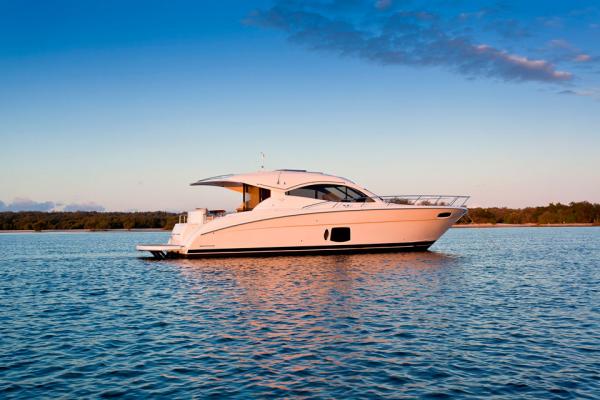
Fluid lines wrap the 50SC’s most appealing interior in a well-proportioned shell — one that combines automotive themes with traditional yachting elements. The plunging sheer line and shape of the windows in the house visually extend the yacht’s length, and the extended roofline elevates the profile a step or two above a typical express boat.
Like every IPS yacht I’ve driven, the Maritimo tracks as though she were on rails, making the autopilot seem unnecessary — at least in relatively smooth water. This yacht rides on a warped-plane, V-shape bottom of moderate deadrise at the transom. Although we didn’t have any seas to speak of, Krueger says that his experience aboard her in rougher waters proved that she’s a good sea boat. The parallel thrust of the IPS, as opposed to the down-angle thrust of shafts and props, caused the 50SC to run at about 6.5 degrees bow up with neutral tabs. This in no way limited my sight lines from the helm, nor did it affect the boat’s speed during my time aboard. She responded instantaneously to steering input, dipping her inside shoulder in tight turns and losing almost no speed — this behavior is also a result of IPS drives and a well-shaped bottom.
Is this the perfect midsize yacht? It may very well be for those folks who like high style, entertaining friends and cruising in comfort. And who doesn’t?
Maritimo, 206-462-6080; Galati Yacht Sales, 616-738-3108.
Watch a video of the Maritimo 50SC here.
Click here to see more photos of the Maritimo 50SC.
Find more yachts from Maritimo here.