Fidelis
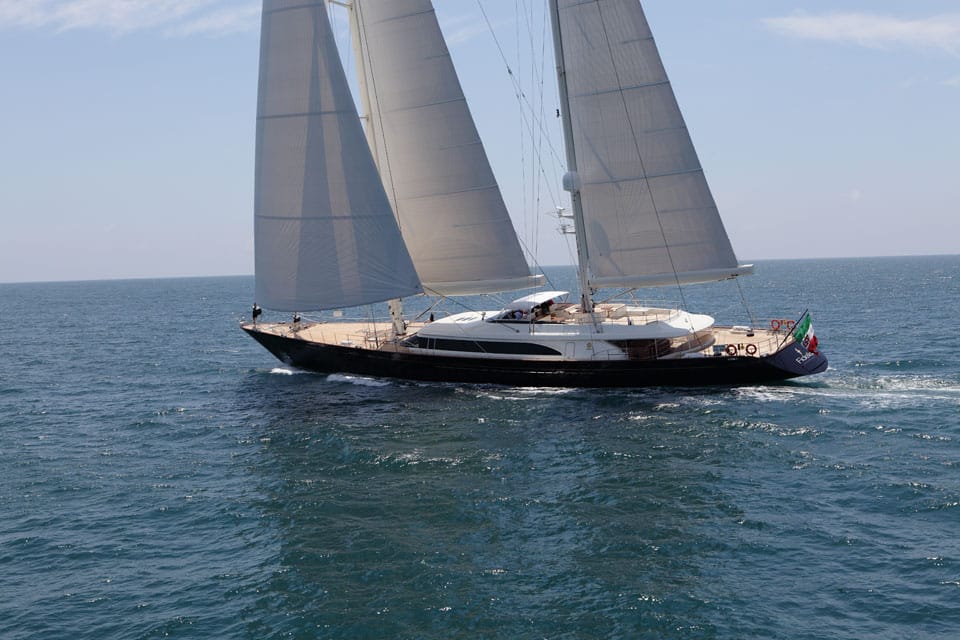
Oh, my, how easily a 184-foot sailing yacht becomes the perfect vessel. Her once overwhelming size diminishes with familiarity, especially when she’s in the company of siblings gathered for a couple of days of racing. Her luxurious and spacious accommodations, though never taken for granted, make strangers feel welcome. Fidelis, a 56-meter Perini Navi ketch, is a perfect example. After spending a day aboard her during the Perini Navi Cup in Porto Cervo, Sardinia (see video below and a complete photo gallery here), this past September, I realized that she, and others of her ilk, could be the ultimate in world-girdling cruising yachts.
At sea, big is always better than small, especially if the naval architect and builder get all of their sums correct. A well-designed, 56-meter heavy-displacement yacht has a gentle motion, a long waterline for high average speeds and enough freeboard to keep the seas from mounting the deck. It also has a tremendous amount of usable volume belowdecks, which provides the owners, and their interior designer, with more options than they can easily consider.
Over a bottle of limoncello and several cups of espresso, the sensitive designer will have discovered enough about the clients to mingle his pet ideas with theirs. The happy result: The designer has fun and the owners love their yacht.
View a complete photo gallery of_ Fidelis_ here.
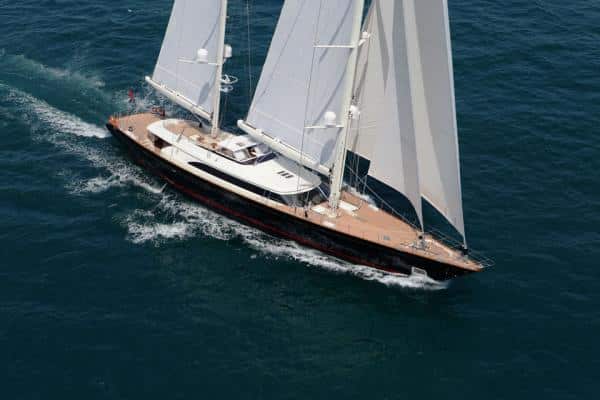
Yachts of this size and complexity require many brains to design, style and engineer. Ron Holland provided the naval architecture in collaboration with Perini Navi’s design staff, and his input shows in Fidelis‘ clean wake. You’d expect such a heavy yacht to dig a big hole amidships and sculpt a frightful quarter wave in her effort to exceed the traditional speed/length ratio of 1.34, but Holland’s design keeps wave-making resistance to a minimum. Even at 1.34, Fidelis has a top speed of 16.45 knots, but I had no way to confirm her ability to reach, or exceed, that speed in the light air off Porto Cervo. On the upside, the ratio of sail area to wetted surface allowed her to ghost along at 5.4 knots in a true wind speed of 8 knots, 40 degrees to the apparent wind.
Fidelis is the 10th example of the 56-meter series, which began in 2003 with the launch of Burrasca. All of these, save the sloop Salute, are ketches. Perini’s design team styled the entire 56-meter series, and keen observers easily will recognize the similarities among the fleet. They’ll need an even keener eye to spot the differences. Most are subtle and appear in the superstructure, because the hull of each 56m is the same as every other. Perini Navi builds the aluminum shell of these yachts at its yard in Turkey, and commissions them at the yard in Viareggio. Aluminum doesn’t require permanent tooling, so alterations in the characteristics of the superstructure are relatively easy and economical. Perini’s willingness to accommodate the client’s preferences lets owners establish a personalized identity for the public face of their yacht.
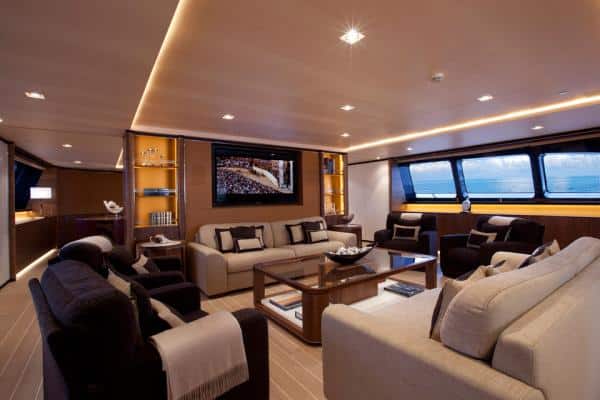
Owners rarely get the chance to see their Perini Navi from the perspective they need to in order to embrace every nuance of its exterior design. Most often they’re too close, but inside the yacht, close is good, as I discovered when I stepped from the afterdeck through one of the curved glass doors and into the salon of Fidelis. The word clutter doesn’t exist in this owner’s lexicon, and because of that, the main salon made me think of a desert landscape dotted with exactly the number of dwellings necessary to support its small population. Perini’s interior design team, headed by the legendary Bernardo Chichi, and the owners selected whispering earth tones, accented with shouts of black and dark wood, reds of the U.S. Southwestern desert and shiny metal.
This blend of soft and hard, with intimate islands of furniture and throughways of wide teak planks bleached to the color of sand nearly stopped my heart.
The decor, however, did stop my progress. A pair of full-figure sofas and a handful of equally inviting, slightly overstuffed armchairs on the flanks beckoned me to sit a while, sip champagne and listen to tales from the previous day’s racing. I sampled a chair, but the champagne and companions failed to appear. Other treats did. Even though we were in race mode, stewardesses flitted to and fro — outbound carrying a variety of victuals and drinks from the galley belowdecks to the many guests taking shelter from the sun on the afterdeck or watching our progress around the buoys from the flying bridge; inbound carrying empty glasses, plates and the detritus of lunch. They moved very quickly and quietly and seemed immune to the yacht’s motion and angle of heel, such as they were in the light conditions.
A pair of glass pocket doors, elegantly curved and framed in stainless steel, separates the interior’s salon from its counterpart on the afterdeck. When the doors are wide-open, the two salons become one and traffic flows easily in both directions. The structure that surrounds the staircase on the yacht’s centerline divides the main salon into two distinct sections. Forward of the cozy seating area that I’d occupied earlier, I found an open space containing an intimate dining table for eight on the port side and a game table for four opposite. Large windows on both sides of the main deck absolutely flood it with natural light, and the area is so spacious that a teenager on a skateboard might find it an irresistible venue.
When the owner guided my tour of the lower deck, we descended from the main salon via a loosely spiraling staircase that terminates in a large foyer off the master stateroom and the four smaller staterooms forward of amidships. This is the lower section of the centrally located stairwell, which connects all the decks and gives the owners and their guests easy access to all levels. The treads rest on stringers, clad with polished stainless steel and defined by their gracefully changing depth throughout the rise. A single open balustrade on each side and the absence of risers give the staircase a delicate appearance and prevent it from dominating the spaces near it. If the staircase were human, it would be a ballerina supine on a chaise.
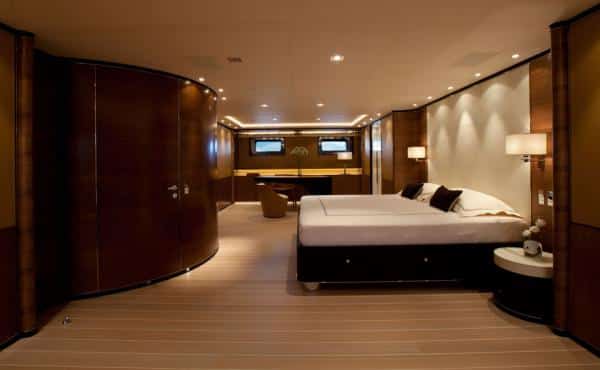
The master stateroom spans the entire beam, and when we entered, the owner told me that he and his wife may have overindulged a bit. Allowing for the intrusion of framework, insulation and decorative panels along the inside of the hull, this stateroom is about 35 feet across. To my surprise, this huge area felt wonderfully cozy, and I think I know why — muted colors, simple lines, cylindrical shapes. From the foyer you may enter the stateroom via a door to starboard of the centerline or to port. Each entrance reveals a unique ambience. The portside door opens onto the office area and face-to-face with a schizophrenically elegant desk. Anchored on one side by a thick tapered base — home for a few drawers — the desktop cantilevers in a subtle curve to its terminus. This mostly dark brown piece has a white insert where a conventional blotter would rest, and that opens onto a shallow stowage space.
Entering via the starboard door leads you to an intimate sitting area, dominated by a puffy armless sofa, a simple coffee table and two barrel chairs, covered in butterscotch leather and off-white fabric seat cushion and back. A king-size bed occupies the place of honor on the centerline. The massive dressing room/closet and two heads — his on the starboard side, hers opposite — occupy a significant amount of area between the main part of the cabin and the machinery spaces aft. Although the oval shape of the foyer encroaches on the stateroom, it does so in a pleasant way, psychologically separating the two sides of the stateroom.
As you’d expect of any good sailing yacht, proof of its value lies in the performance. Although modern steering systems — joystick control under sail among them — isolate the helmsman from tactile feedback, that doesn’t take anything away from the thrill of helming a large and powerful yacht through the water. Perched on the flying bridge and steering from the high side, watching the water rush by the rail more than 30 feet below you, could stop your heart. Any techno-enthusiast owner simply has to marvel at the systems and Perini Navi’s skillful installation. If he also wants to keep fit, he may join the foredeck crew. In spite of the powerful captive winches doing the true grunt work of handling the sails, the guys and gals on the foredeck still have to heave, en masse, on the lazy sheet while the hydraulics furl the genoa so it clears the inner forestay during the tacks.
Lovely yachts and an enthusiastic group of owners endeared me to the world of Perini Navi, and I look forward to another injection of their camaraderie.
To view an extensive photo gallery of Fidelis, click here.
See a complete photo gallery of the Perini Navi Cup, click here.
LOA: 183’9″
LWL: 150’11”
BEAM: 37’10”
DRAFT: 13’0″ keel up, 31’11” keel down
DISPL.: 1,201,519 lb.
FUEL: 14,000 gal.
WATER: 4,490 gal.
ENGINES: 2 x 1,450 hp Caterpillar C32 ACERT diesels
SAIL AREA: 16,146 sq. ft.
SPEED: 15 knots at maximum power
RANGE: 3,500 nm at 12.5 knots
Perini Navi USA, 401-683-5600; www.perininavi.com