
William Hand
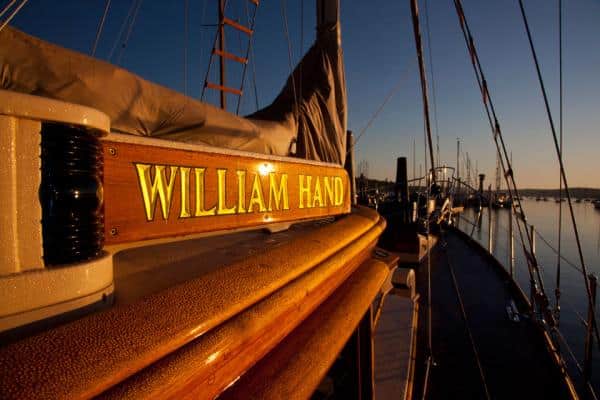
“Look at this,” I said to no one in particular. I was alone on the dock at the Newport Shipyard admiring some of the yachts in the 2010 Newport Brokerage Show. The profile looked familiar — short ketch rig, springy sheer line, upright pilothouse, cambered coach roof and the sweetly curved stem struggling to go plumb. A heartbeat before I congratulated my power of recall, I read the name board on the side of the house — William Hand. Of course.
Capt. Joe Talbot of Midcoast Yacht Brokerage in Camden, Maine, poked his head out of the pilothouse door to say hello.
“Permission to come aboard?”
Talbot nodded, and by then, my colleagues were at my back, sighing more loudly than a 15-knot wind in the rigging. Maybe 20 seconds after I stepped into the salon, I was ready to move aboard. Failing that, which was inevitable because she’s on the market for $2.3 million, I wanted to write a feature story about this 60-foot motorsailer — 63 feet if you count the bowsprit and anchor roller. Everyone agreed, so here we are — a year and most of a day aboard_ William Hand_ later — to share with you (view the complete photo gallery).
The Hodgdon Brothers, East Boothbay, Maine, built William Hand in 1933/1934. Her owner christened her Bluebill II, since she was a replacement for his first Bluebill, a 55-footer also designed by Hand and built by Hodgdon in 1928. I found the first Bluebill listed for sale, without a price quoted, in Hand’s brokerage advertisement in the January 1933 issue of Yachting.
William Hand was a versatile and prolific designer who frequently took inspiration for his designs from workboats of the period, and the focus of his enthusiasm at a given time determined the type of boat he designed and marketed. He also built and used boats he designed, which allowed him to evaluate them and make changes to subsequent yachts for his clients.
Prior to World War I, Hand focused on V-bottom powerboats, which he based on the Chesapeake Bay deadrise workboats. After the war, schooners caught his fancy, and he studied the Gloucester fishing schooners for inspiration. Compared with the Gloucester’s relatively deep forefoot and shallow keel, Hand’s schooners have a cutaway forefoot and a deeper keel, the foot of which gets deeper as it goes aft. Hand avidly liked swordfishing and drew Whistler, a 61-footer, for that purpose. In fact, he made a successful business of fishing and every year built a new schooner, used her for a season and then sold her.
His experience swordfishing taught him that the deep body of a schooner’s hull made a steady platform for a harpooner and his lookout aloft, but the fishing boat didn’t need the deep keel and large sail plan of his schooners. Although the shapely underbody of Hand’s schooners made them easily driven and seakindly under sail, the motorsailers he envisioned would spend more time upright or at a moderate angle of heel and required different waterlines. He got the underbody he wanted by extending the waterline of the schooners, which shortened the overhangs. The cutaway forefoot and substantial drag of the schooners’ keel evolved into a relatively deep forefoot and nearly level keel on the motorsailer. He switched the rig to a ketch, decreased the total sail area and relied on powerful Hall-Scott gasoline engines for most of the motive force. The smaller rig would stabilize the boats in beam seas and allow the skipper to heave-to.
Even at maximum speed, these hulls barely disturbed the water’s surface — the modest bow wave dissipating long before it developed into a noticeable quarter wave. On the other hand, the slack bilges and narrow beam at the waterline allowed the motorsailers to roll in beam seas, especially under power with the sails furled. Hoisting the sails reduced the roll, but not significantly unless the wind blew hard enough to keep the sails full and drawing.
Capt. Philippe Sée (pronounced “say”) welcomed me aboard William Hand at Strouts Point Wharf Co., South Freeport, Maine, on a bright, warm and nearly windless morning this past August. Exploring a bit of Casco Bay seemed like the perfect way to get acquainted with the William Hand, because it’s a lovely place to cruise and Mr. Hand was born in Portland in 1875.

From the float to the boarding step to the wide side deck, climbing aboard the William Hand was easy. On the other hand, I had to step over a fairly high sill and duck through the height-challenged door to reach the pilothouse. That little bit of effort rewarded me with sights and smells of another era. Just as I remembered from my first visit a year before, the woodwork glowed like the finest U.S. Grade-A Light Amber maple syrup, the chrome-plated instrument bezels scattered spikes of reflected sunlight in every direction, and the six-spoke chrome-plated steering wheel still made me think of Vitruvian Man. The vintage instruments set into a chrome-plated panel on the dashboard were in place when the current owner bought the boat. They may be original, or at least from the correct period. A vintage brass binnacle, housing a rebuilt compass from the 1930s, sits forward of the dashboard, and its height, I discovered later, let me “see” the heading while I scanned the water in front of the bow. A taller helmsman may not be able to do this, because the compass probably would be out of his peripheral vision.
A pair of wicker chairs beckoned from the starboard side of the house. I settled onto the soft cushion of the forward one and leafed through an album of photos from the restoration work. The William Hand had been rebuilt below the waterline, using Monel fastenings, before the current owner bought her. Green Marine did the remaining work at the Royal River Boat Yard, because Walter Green’s yard didn’t have the physical space. Workers hauled the boat and built a shed around her, where she lived for more than two years while work progressed. She received new deck beams, carlins, ribs and an entirely new deck, using two layers of marine plywood set in epoxy resin, and finished with three-quarter-inch teak, also set in epoxy. Epoxy mixed with graphite forms the black seams between the teak planks. Her laminated oak stem is new and so is the double-planked teak transom. About a third of the original planking above the waterline was in great shape and was retained. All of the new fastenings above the waterline are made of silicon bronze. Although the pilothouse was in good condition, the trunk cabin and a lot of the interior joinery required refurbishing.
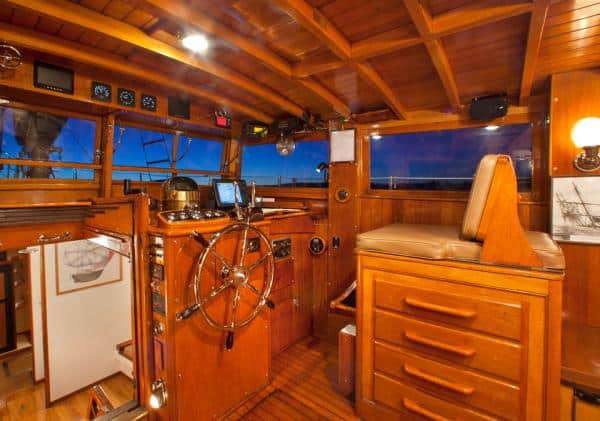
Old wooden boats captivate us for a wide variety of reasons: Most of the structure is right there to see, reassuring us of the boats’ integrity; their relatively narrow beam creates a wonderful coziness; the general arrangement plans are logical and suit the boat’s use; the wood absorbs sound and insulates the accommodations from the cold sea; and the smell of oil-based paint and varnish always lingers, however faintly.
The beam of William Hand is about a quarter of the waterline length, and the hull is deep. Descending the steps to the salon forward of the pilothouse took me to what seemed like an impossible depth. The stairs are fairly narrow and the pitch a bit steeper than is customary aboard modern yachts, but the salon surprised me. Although it’s deep within the hull, the white tongue-and-groove overhead and ceilings reflect most of the natural light streaming through the portholes in the topsides, the deadlights along each side of the trunk cabin and the butterfly hatch in the overhead. All this whiteness also makes the best of the electric light at night. The dinette on the port side seems large enough to seat six at the drop-leaf table if you place a couple of chairs at the inboard side. Opposite the dinette is the pilot berth/settee.
The galley, spanning the full beam forward of the salon and head, has the sink and counter on the port side, Norcold refrigerator/freezer on the centerline and stove on the starboard side. The cooking area is relatively tight and seamanlike, giving the chef a variety of options for bracing himself in rough seas. The modern appliances don’t look out of place, I suppose, because they’re useful, and what good is having a lovely old yacht that you can’t use?
Tucked into the bow of the William Hand, the crew’s quarters are a perfect spot for a trio of children. The cork sole will withstand a lot of abuse, and it’s naturally anti-slip. Stacked berths line the port side, and a single berth atop a couple of stowage lockers fills the starboard side. The kids will love going topside via the vertical ladder and raised hatch, as much as the professional crew of the 1930s probably disliked the exit.
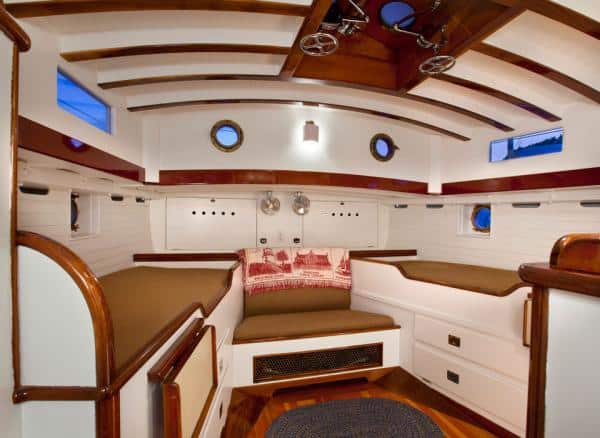
Keeping the crew and owners at opposite ends of the boat is an ancient tradition, so Hand placed the owner’s stateroom abaft the pilothouse and the machinery space beneath it. Maybe at the owner’s request or maybe because certain circles of the yachting world frowned upon co-mingling of the sexes, this yacht doesn’t have a genuine double berth — only the convertible dinette in the salon, but I doubt that it’s original. In the master, a single berth on each side nestles hard against the hull, separated at the foot by a settee.
Each berth has wide drawers under it and each berth has a fold-up night table at the head. Wake early on a dreary day at the anchorage, prop yourself on a pile of luxurious pillows and wait for the crew to deliver coffee and a scone. If the book that you’d been reading the night before beckons from the night table, read for an hour before giving the order to weigh anchor. If you wake to bright sunlight and a light breeze from the butterfly hatch on the centerline and the portholes adjacent to your berth, take coffee and a scone in the pilothouse or the salon. Not a minute to lose on such a fine day.
By the time I’d exhausted my fantasy tour, Sée announced our departure by firing the Detroit Diesel 6-71 engine. It burst into life before the crankshaft completed a single full revolution. As the engine warmed, we cast off our lines and then gently motored away from the float.

Just as I had expected, the only way to fill the sails in the very light air was to build apparent wind under power, so we left them furled. A pity, in part, because I would have enjoyed seeing what sort of numbers the B&G sailing instruments showed. Taking advantage of the motor half of the William Hand, we “hustled” right up to hull speed and enjoyed her graceful progress through the calm sea. Boats of this ilk require patience from the helmsman. She refuses to be rushed and makes sure you don’t try to hurry through any maneuver by being stiff on the helm and slow to turn. Considering the 30 feet, or so, of cable between the wheel and the rudderpost, I’m surprised she steers at all without power assist. No matter; we weren’t running a slalom or navigating a sea of lobster pots.
As we closed on our place at Strouts Point Wharf, I savored the short time aboard and imagined what I would change. All of her mechanical systems are modern, save the engine, though the 6-71 is postwar and definitely an upgrade over the original gasoline engine. Power steering? Maybe, but would you add power steering to your restored 1933 Rolls-Royce Silver Cloud? I chose leaving her as she is, and I still want to move aboard. Now, where will I put my office?
LOA: 63’6″
LWL: 59’0″
BEAM: 14’0″
DRAFT: 5’0″
DISPL.: 40 tons
(full load)
ENGINE: 1 x 120 hp Detroit Diesel 6-71
FUEL: 700 gal.
WATER: 300 gal.
PRICE: $2.3 million
View the complete photo gallery.
Midcoast Yacht Brokerage, 207-701-9998; www.midcoastyacht.com