
Oil Rx
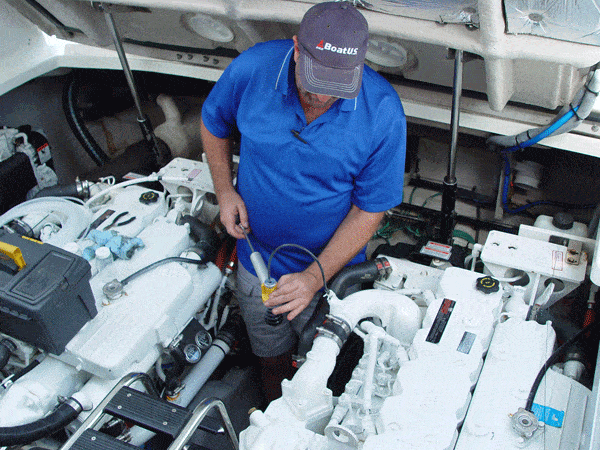
Doctors warn it’s better to catch health problems early through routine screening than to wait for symptoms. The same approach applies to caring for diesel engines. Fortunately, maintaining diesels requires less effort than keeping up with our health. Regular oil changes and routine oil monitoring prolong the life of an engine by helping technicians detect problems before parts fail.
Some boat owners might extend service intervals to try to save a few bucks. But metal particles from wear, soot, dirt, water and other contaminants that accumulate in the oil grind metal. The longer that oil is in the engine, the faster parts wear, costing more money for repairs over the long run.
“Those particles and contaminants also accelerate oxidation,” said David Cline, product manager of oil filtration systems for Parker Racor. “As it oxidizes, oil thickens and becomes less effective at start-up, causing metal-to-metal wear.” Those few seconds after start-up — before oil has had a chance to flow throughout the engine — are responsible for much of an engine’s wear.
Oil viscosity is based upon standards set forth by the Society of Automotive Engineers. SAE 30 oil, for example, flows more easily than “heavier” SAE 50 oil. Oil also thickens as temperature drops. Prefixes such as 10w denote cold-weather starting viscosity — 10w40 oil acts like 10-weight oil when cold, flowing readily between the moving parts, but then provides the protection of 40-weight oil at the normal operating temperature.
Engine designers might choose heavier oil to stand up to pressure where parts press against one another, but they also know lighter oil creates less internal resistance, increasing usable horsepower and fuel economy. Balancing the two requires oil that hasn’t been thickened or thinned by oxidation or contamination beyond what’s expected within suggested service intervals.
Oil also does more than lubricate. “Injectors are often operated by oil, so they’re quite susceptible to dirty oil,” Cline said. “Turbochargers have very little tolerance for oil contaminants too.” As engines produce more horsepower from a given configuration, they place more pressure on parts that the oil is supposed to protect. Pistons are cooled with oil, heating it and accelerating oxidation.
Just as our own blood absorbs cholesterol from our diet, engine oil retains harmful contaminants extracted from diesel fuel. Sulfur, for example, mixes with condensation inside an engine to form sulfuric acid, which eats the internal components, even while boats sit in their slips. Additives blended into oil help mitigate engine damage. Standards set forth by the American Petroleum Institute and other international agencies indicate how well oils lubricate, clean and prevent corrosion inside particular engine types. Oil for gasoline engines is labeled “S” (for spark ignition), for example, while oil for diesels is marked “C” (for compression ignition). Engine manufacturers rely on API ratings to specify oil that’s best suited for a particular engine, underscoring the importance of using recommended oil.
And just as a doctor can order blood work to pinpoint health issues, engine oil can be checked for unusual concentrations of metal particles, dirt, seawater, antifreeze or other contaminants that indicate specific problems. “Testing gives you the condition of the oil and, indirectly, the condition of the engine,” said Charles Boswell, president of R&G Laboratories in Tampa, Florida. A high concentration of stainless steel, for example, indicates a shaft is wearing. Copper comes from excessive brass- or bronze-bearing wear. Chrome warns of piston ring problems, while tin raises concerns with cylinder walls. Contaminants from outside the engine are also important indicators. High sodium, for example, shows that seawater is finding its way into an engine, while potassium indicates that antifreeze is leaking internally.
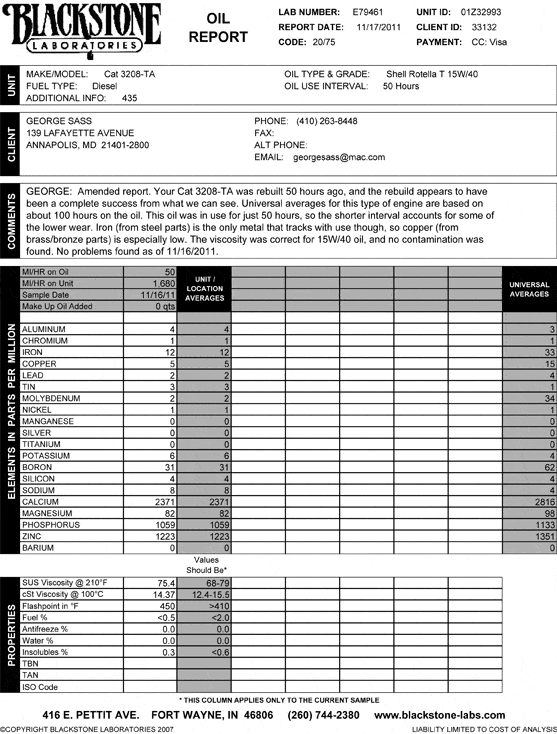
Most boat owners only see oil analysis reports taken by an engine surveyor when they buy a used boat, and most boat sellers change oil just before that survey. “There is no way to determine the age of the oil,” Boswell said of oil submitted at survey. “You’re looking for gross indicators of something going severely wrong. The best use of our technology is tracking and trending over time.”
“Take an oil sample at every oil change,” said Charlie Schloemer, president of Palm Beach Power in West Palm Beach, Florida. “Send it to the same lab each time. It’ll build a graph showing what’s going on inside your engine.” Indicators might be within specifications, but if they’re steadily increasing, a problem is developing. “Fuel soot tells you that you’ve got eroded injector tips. You’re overfueling the engine,” Schloemer said. “That generally comes on gradually, over time.” Routine oil analysis raises such concerns early.
“If we’re tracking and trending, we’ll often find a problem early, but we need to have previous samples for a reference point,” Boswell said.
Schloemer also said that many indicators are engine-specific. “On four-cycle MTU engines, iron shouldn’t be over 30 parts per million, but on two-cycle Detroit Diesel engines, it can be up around 150 parts per million.”
“You’ve got to have that mechanical expertise aboard the boat,” Boswell said. “If we find high copper, the mechanic or engineer has to know where that copper might be coming from.”
Some problems may show up suddenly. “One of the most important tests we do is for viscosity,” Boswell said. Water in the oil can cause oil-thickening sludge, accelerating start-up wear, while diesel fuel leaking into the oil thins it so it won’t properly lubricate. R&G Labs also goes beyond ordinary oil analysis techniques to address specific concerns. Using analytical ferrography, for example, Boswell looks at oil under a microscope. “Normal wear particles are shiny and smooth,” he said. “Abnormal wear might cut or abrade. Those particles look like ribbons or show striations under a microscope.”
And like a blood-work laboratory, oil labs charge based on tests requested. For around $20 per sample R&G Labs uses atomic emission spectroscopy to measure specific elements within the oil. Technicians also test viscosity and check for water. Analytical ferrography, which adds time and requires expertise, is around $75 per test.
“[If] we keep seeing the same problem again and again in an engine’s oil samples,” Boswell said, “there needs to be action at the other end to resolve the problem.” That sounds an awful lot like my doctor when she looks over my blood work at each yearly physical.