Rose Point Main
Living in Seattle offers a unique view of technology. Visit any trendy neighborhood (or marina) and you’re likely to see casually dressed urban professionals tapping Apple devices. Drive east across Lake Washington, however, and the road leads to Bellevue, Washington — Microsoft’s hometown.
Just to the northeast of this PC boomtown is Redmond, a bedroom community for Microsoft employees and the home of Rose Point Navigation Systems, a company that specializes in PC-based navigation software. Brad Christian, Rose Point’s founder, was an early Microsoft employee who left for a cruising lifestyle aboard his 57-foot Bayliner in 2001. Frustration arrived, however, when Christian tried using the available PC-based navigation systems, which he described as “clunky and nonintuitive.” Also, these programs had a reputation for crashing, and for a less-than-ideal user interface — descriptors that the Apple-hugging crowd often tosses at “Microsofties.”
The problem, Christian said, was that existing PC-based navigation software suffered from its own evolution, which added layers of software that gunked up the architecture and reduced user “discoverability” and reliability. Given his background as a key project manager of Microsoft’s C++ (versions 5 and 6), Christian understood that the only way to get the software that he personally wanted was to build a new system from the ground up.
He started by creating a matrix of every conceivable feature that serious cruisers would want. He then began writing the software that could support these needs, even if they weren’t initially bundled with the program (e.g., weather information), while placing a high value on simplicity and usability. “Things should just work,” Christian said of his software — decidedly Jobsian speak for a man with a Gatesian background.
When Christian wrote his Beta version, he had little intention of getting back into the software business, but when his friends remarked on how stable, intuitive and easy the program was, he realized that he had created a tool that could revolutionize the PC-based navigation market. Christian began working on a consumer version and founded Rose Point Navigation Systems in 2003. Coastal Explorer was unveiled in February 2004 at the Seattle Boat Show, and the business began to grow, leasing offices and making hires.
One fortuitous interview unfurled at the Seattle Yacht Club when Christian was randomly seated with Jeff Hummel, a former Nobeltec (cms.nobeltec
.com) employee who was instrumental in creating the first radar overlay for PC-based navigation software, and for getting vector charts to run properly on the Nobeltec platform. The conversation swung to business, and Hummel started working full-time for Rose Point as director of sales and marketing in December 2004.
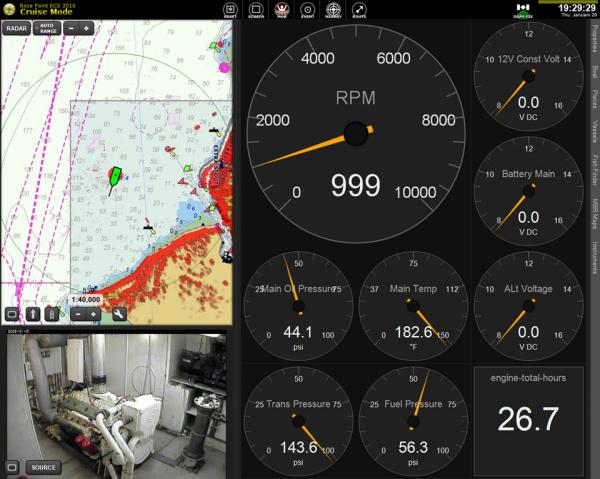
“Being boaters, we know the features that people need — we’re not into frilly bells and whistles,” Hummel explained, citing 3-D charts as an example. They aren’t useful, he said. They look great at a boat show, but you can’t use them for navigation. Instead, Rose Point focuses on essentials, such as routing, cruising-guide information, weather and tide information, and radar and AIS overlays, while maintaining an intuitive user interface.
Since the beginning, Coastal Explorer has covered everything from the recreational market to sub-SOLAS-class vessels (e.g., inland towing, coastal towing and offshore oil and gas vessels). “I was in Port Fourchon, Louisiana, talking to the captain of a commercial offshore-supply vessel about 16 months after the product went into the field,” Hummel said. “They’d been running the software the entire time — 24/7 — with different operators using it. I asked if the program ever crashed — the captain looked at me horrified and asked ‘could it crash?’ The only way you can achieve a track record like that is through clean architecture.”
Christian’s Microsoft background also instilled the value of thorough R&D prior to any releases. “We use an R&D model that’s long on experience,” Hummel said. “It’s got to work and you don’t want to release it until it’s proven.” As for hard miles, Hummel advised that Coastal Explorer has rounded Cape Horn and has been used extensively on high-latitude cruises, despite a moniker that suggests otherwise.
Also refreshing in the computer world, where Moore’s Law — which states that the number of transistors on a chip roughly doubles every two years — still reigns, is that Coastal Explorer doesn’t require a now-generation PC. This matters, since Rose Point’s market research reveals that most boaters make six to 12 trips per year, plus two extended cruises. Minimize the necessity of upgrading and relearning software and hardware processes while maximizing usability, Hummel said, and you increase user confidence. “We’re not relying on hard-wire acceleration for the graphics,” he said. “We use what can be found in most computers.”
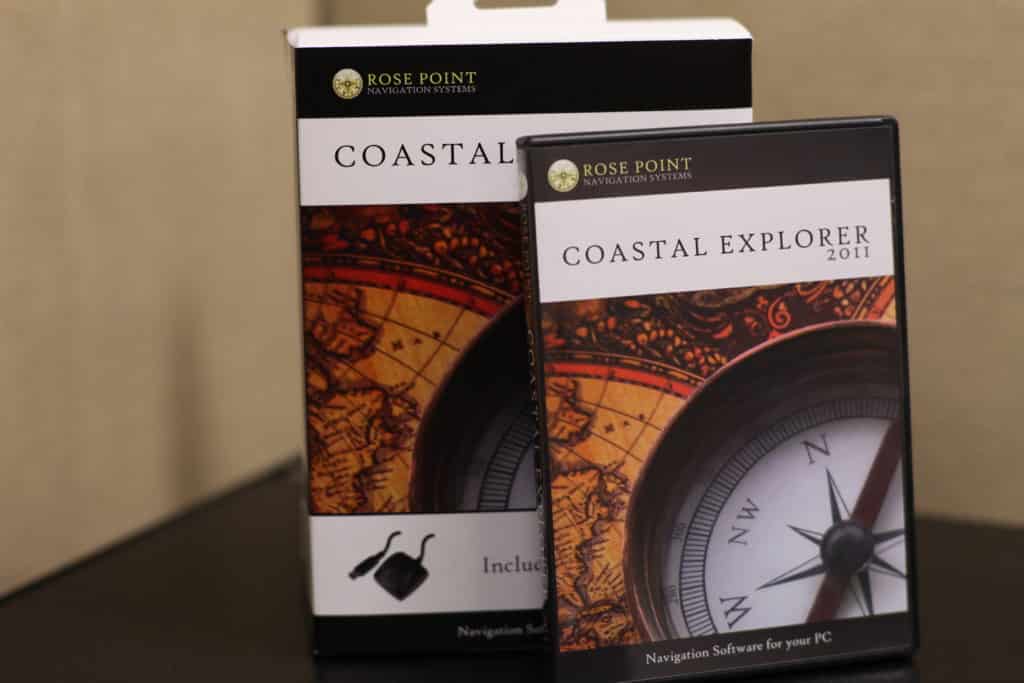
To demonstrate, Hummel presented Coastal Explorer 2011 on a dated-yet-capable Panasonic Toughbook. Here, Hummel showed how the program supports a wide range of cartography, including products from the National Oceanic and Atmospheric Administration, Maptech and Navionics, as well as add-on utilities, such as Active Captain and Atlantic Cruising Club marina guides. Also handy is the ability to create both public and private blogs, which are hosted on a Rose Point website; users can write and edit offline and then click “synch” when they’re ready to transfer data, saving time and money when Internet access is spotty. Hummel said that Coastal Explorer is the only PC-based navigation software to offer a “check-for-obstacles” routing function and the only one to offer an “infinite undo/redo” option.
While software put Rose Point on the map, the firm has also logged plenty of R&D hours on the hardware side of the equation. “We only do hardware to the extent that others do not,” Hummel said, referring to Rose Point’s limited-but-increasing hardware menu. An example is the NMEA 2000 Gateway, a NMEA-to-USB connection cable, which Rose Point purports is the easiest way to pump NMEA 2000 information into a PC. “It’s totally future-proof — it only takes data from the bus.” Hummel was careful to explain that the NMEA 2000 Gateway was designed to be forward-compatible because data processing is done on the PC, and not in the Gateway. Other hardware offerings include the new NMEA 2000 engine interface, which generates PC-compatible data from all engines, including older analog units, as well as original equipment manufacturer level GPSs and radars.
Christian and Hummel envision more hardware releases, as well as an evolution of software that emphasizes Coastal Explorer’s clean architecture and intuitive user interface. An obvious upcoming release is an iPad app that will provide wireless access to Coastal Explorer. “The iPad is a paradigm shift,” Hummel said. “People buy products to deliver information — if an iPad is a better way to deliver that information, that’s where people will go.”
Despite a stagnant economy, Rose Point has enjoyed robust growth. While the company is cagey about divulging key numbers (annual sales, number of clients or number of employees), Christian maintains that it has “enough people to get the job done,” and Hummel let slip that 2011 was the company’s most successful year to date.
Moving forward, Rose Point plans to continue creating products and features that appeal to boaters and enhance their on-the-water experience. Moreover, Christian will continue to integrate the best hardware and software philosophies from both Microsoft and Apple to grow his own Eden of cruising staples. “We’ll continue to focus on serious cruisers,” Hummel said. “Chart plotters can take people from Seattle to Bainbridge Island. We take them cruising long distances.”