New Orleans, Louisiana
It makes absolutely no sense, but I have always been resistant to the allure of New Orleans. I think it’s a kind of character flaw, a stubborn desire to defy easy assumptions. Friends would say to me, “You haven’t been to New Orleans? Oh, you’re going to love it. It’s so…you.” It’s true: I love jazz, eccentric characters, food, the occasional drink or three — so why in the world wouldn’t I love a town that is steeped in these?
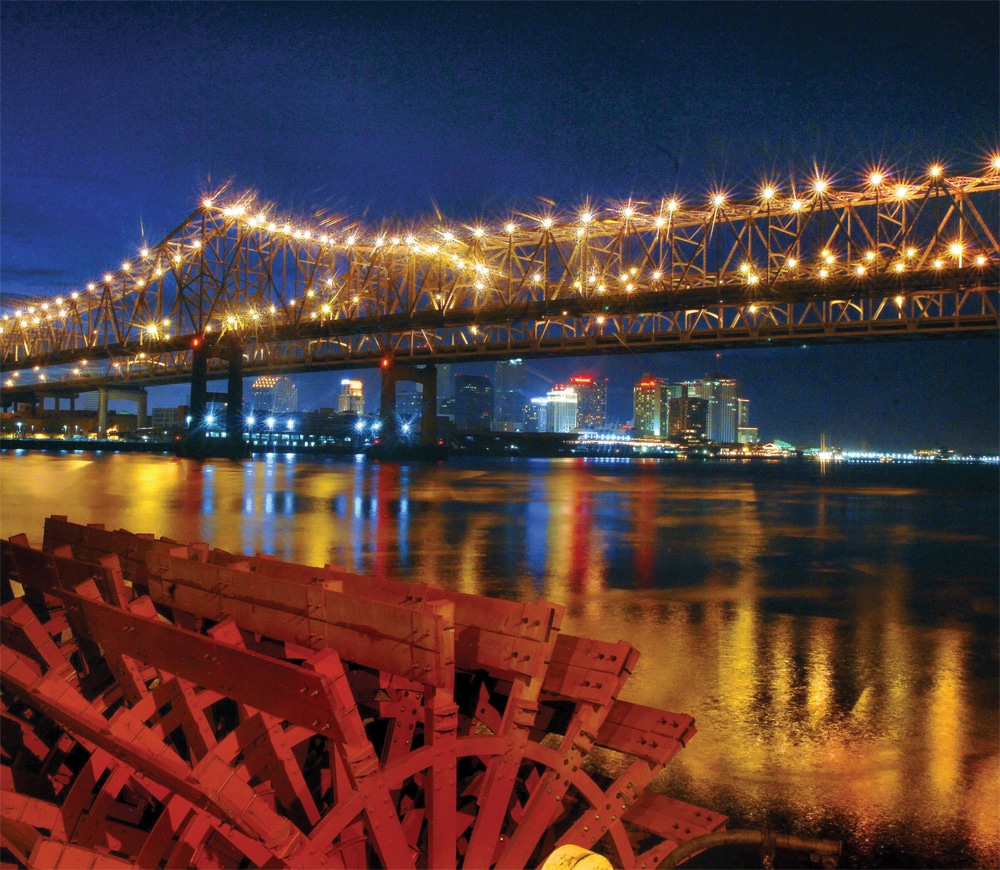
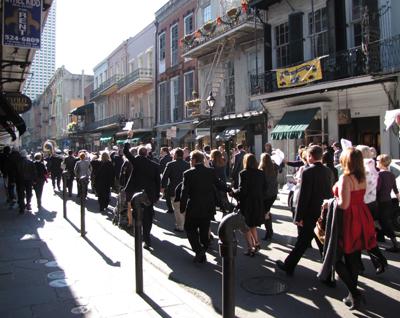
I guess I got hung up on the image of drunken frat boys wandering Bourbon Street with their massive “go cups,” and sloppy girls lifting their T-shirts in exchange for gaudy beads. And, OK, that is definitely a part of New Orleans, in the same way all the other clichéd images of New Orleans are true: beignets at Café du Monde, paddle-wheelers on the Mississippi, brass bands in Jackson Square, voodoo in the air, second line parades down Rue Royale, the gothic eeriness of crypt-filled cemeteries…
The thing about New Orleans is that these moments live are so much more interesting and atmospheric than their legends. And they scratch at the deep mysteries of this city like a moss-draped oak tapping at a storm-darkened windowpane.
New Orleans has often been called the “northernmost Caribbean city in the world.” Its flavor is influenced by more than 400 years of cultural jambalaya. American Indians, the French, the Spanish, the British, African slaves, former Canadian fur traders and gold-rush prospectors, the Civil War and Reconstruction — they all left their mark. There is more poverty and violence in New Orleans than there should be, and the damage wrought by Katrina has left scars that will mark the city’s inhabitants forever.
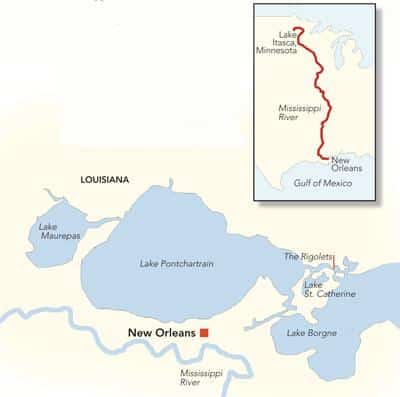
A look at the New Orleans area on Google Earth tells the story. One of the busiest ports in the world, New Orleans is not on any ocean but nearly 100 miles from the Gulf of Mexico, and at the tail end of the 2,320-mile-long Mississippi River. To the south of the city, the fibrous ganglia of the bayous reach out toward the Gulf of Mexico. To the north lies massive Lake Pontchartrain, the second-largest inland saltwater estuary in the United States. To the east are the Rigolets, a tidal strait that connects Lake Pontchartrain to Lake St. Catherine and Lake Borgne, a saltwater lagoon in the Gulf of Mexico. Water is the lifeblood of New Orleans, and its geography — low topography, lots of water, a hurricane hot spot — has been its fate.
But the woes of New Orleans are countered everywhere by its beauty and spirit. The music that pours out of open doorways day and night, the sense of languorous joie de vivre and a sublime sensuousness…these are the hallmarks of a place where life was traditionally so nasty, brutish and short (mosquitoes, fire, floods, war, enslavement) that seizing the moment was not so much an act of optimism as a kind of prescient practicality. Today’s here now. Tomorrow? Who the hell knows? Laissez les bons temps rouler.
I suggest you embrace this approach to life — if not every day, at least when you go to New Orleans. And, yes, start by damning the cholesterol and hitting Café du Monde (www.cafedumonde.com) for some chicory-laced café au lait and a plate of deep-fried dough sprinkled with confectioners’ sugar. Piping hot, the sweet powder melts a little on the beignets’ crunchy edges, and the overall effect makes donuts everywhere deeply ashamed.
Stroll along the Riverwalk and watch the Natchez steamboat pass. Wander toward Jackson Square, pausing to look at the mostly bad artwork that street vendors display against the gates of the park. I found one strange little piece for $20 that I really loved. In front of St. Louis Cathedral, you’ll find palm and tarot card readers, living statues and the usual touristy stuff. But you’ll also probably find a big brass band or some other live music that will lift your mood and make your feet tap. If you have time, visit the Cabildo Museum, where the city’s rich story unfolds in art and artifacts.
I hate to follow fried breakfast food with fried lunch food, but not when it’s an oyster po’ boy from Acme Oyster House (www.acmeoyster.com). Sit at the bar, have a draft Abita Andygator and watch the bartenders’ graceful ballet as they pirouette between pulling beer taps, shucking bushels of fresh oysters and shouting to each other above the din of clattering plates.
After lunch, take a walk up beautiful, tree-lined Esplanade Avenue, the wealthy Creole response to the grand mansions of Charles Avenue built by English-speaking settlers, pausing on Frenchman Street to check out schedules for live music. I heard the Lost Bayou Ramblers (www.lostbayouramblers.com) at D.B.A. (www.dbabars.com) and they were phenomenal!
Some places you visit for a few days and feel like, OK, that was fun — I got a little taste and enjoyed. But leaving New Orleans after a few days was crushing; I felt like I had been invited to the most fascinating dinner party in the world and had to leave after the soup course.
So why in the world did I resist going sooner? I’ll tell you why: It’s because, clearly, I’m an idiot.
An Exercise in Patience
The West End’s waterfront is slowly recovering.
Most of the yacht clubs and marinas in New Orleans are on Lake Pontchartrain in West End and Lakeview, areas devastated by Katrina and now enduring a painfully slow recovery process. Southern Yacht Club (the second oldest yacht club in the country) has been rebuilt but, like New Orleans Yacht Club, does not have transient slips, though there are a handful available at nearby Orleans Marina. Many of the old boathouses have been repaired, and the New Canal Lighthouse reconstruction is due to break ground this spring. The Municipal Yacht Harbor Marina is slated for a $20 million reconstruction but is still only half open. Call ahead for all of these marinas, since this area is a work in progress.
Southern Yacht Club
105 N. Roadway St.
504-288-4200
South Shore Harbor Marina
6701 Stars and Stripes Blvd.
504-245-3152
435 total slips, six transient slips, two large vessel docks
New Orleans Yacht Club
403 N. Roadway St.
504-283-2581
Orleans Marina
221 Lake Marina Ave.
504-288-2351
375 total slips, five transient slips, one large vessel dock